





Why Should You Transplant Strawberry Plants?
Most strawberry plants will produce many runners over the course of its life. For the home gardener, this is great! You get to buy (or otherwise obtain) a few strawberry plants and watch them multiply themselves exponentially. However, the little fellas don’t know when to stop producing runners when the maximum productive capacity of a confined strawberry bed is reached.
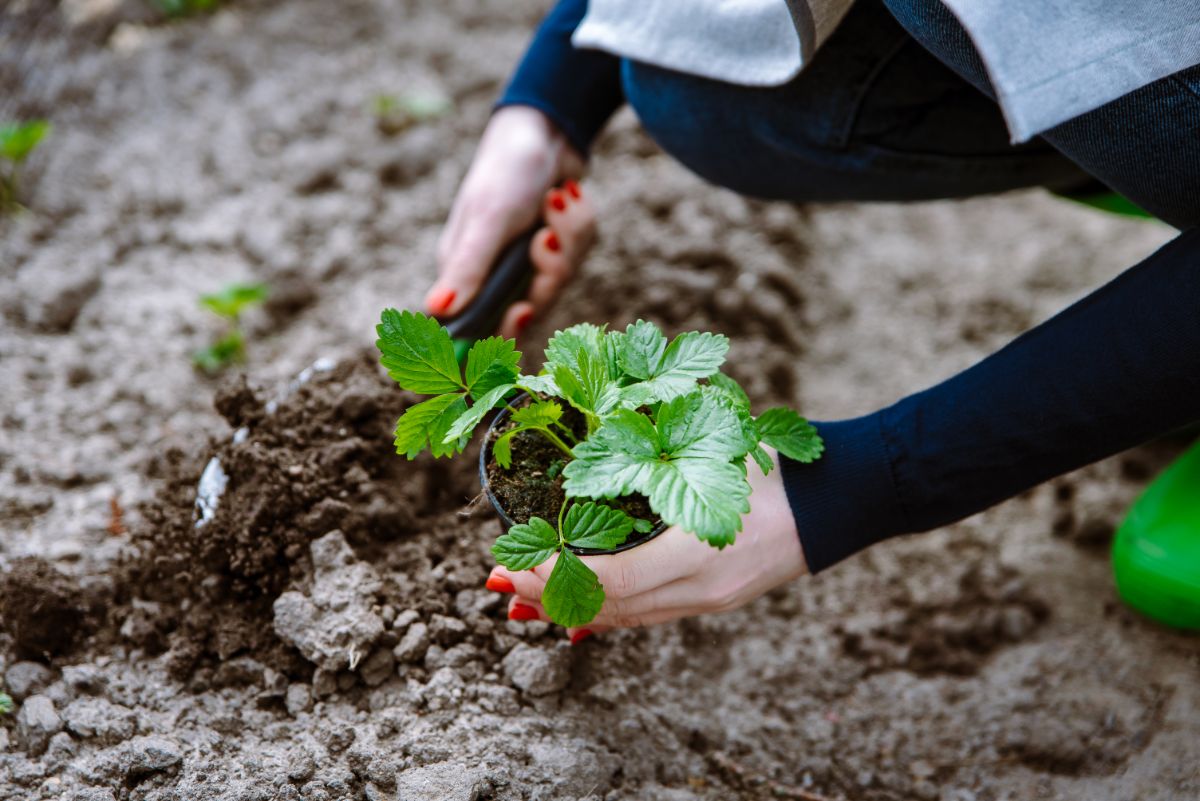
So, a gardener who desires lots of high-quality strawberries will have to remedy this overcrowding. It can be done either by thinning the plants or transplanting the plants to a new area. Also, if the soil isn’t particularly well-suited for growing strawberries, transplanting strawberry plants to a rich, sandy loam with good drainage can make all the difference in the world.
Transplanting the unneeded strawberry plants to new beds can also help develop new strawberry patches and initiate a strawberry bed rotation system that maximizes strawberry production. Additionally, thinning an existing bed by removing and transplanting strawberry plants elsewhere increases airflow which can help reduce many of the fungal diseases (see the Strawberry Plant page for more details).
Jump to:
Transplanting Strawberry Runners
In general, the established plants are going to produce the most and biggest strawberries. It takes some time for a strawberry plant to root well and produce maximally, so a gardener should count on year 2 and year 3 being the years where a strawberry plant is most productive. Some strawberry plants will still produce exceptionally well in year 4, but most will start to lose a bit of their youthful vitality after year 3.
To leave the roots of the most established strawberry plants intact (so that they will continue to produce strawberries at their highest possible level), it is usually best to transplant strawberry runners that were sent off and rooted that year. To make transplanting strawberry runners easier, see the post on Strawberry Plant Propagation. Whether you let the strawberry runners establish at will or guide them so that they establish into moveable pots or containers, the next section will deal with what to do next.
When Is the Best Time to Transplant Strawberry Plants?
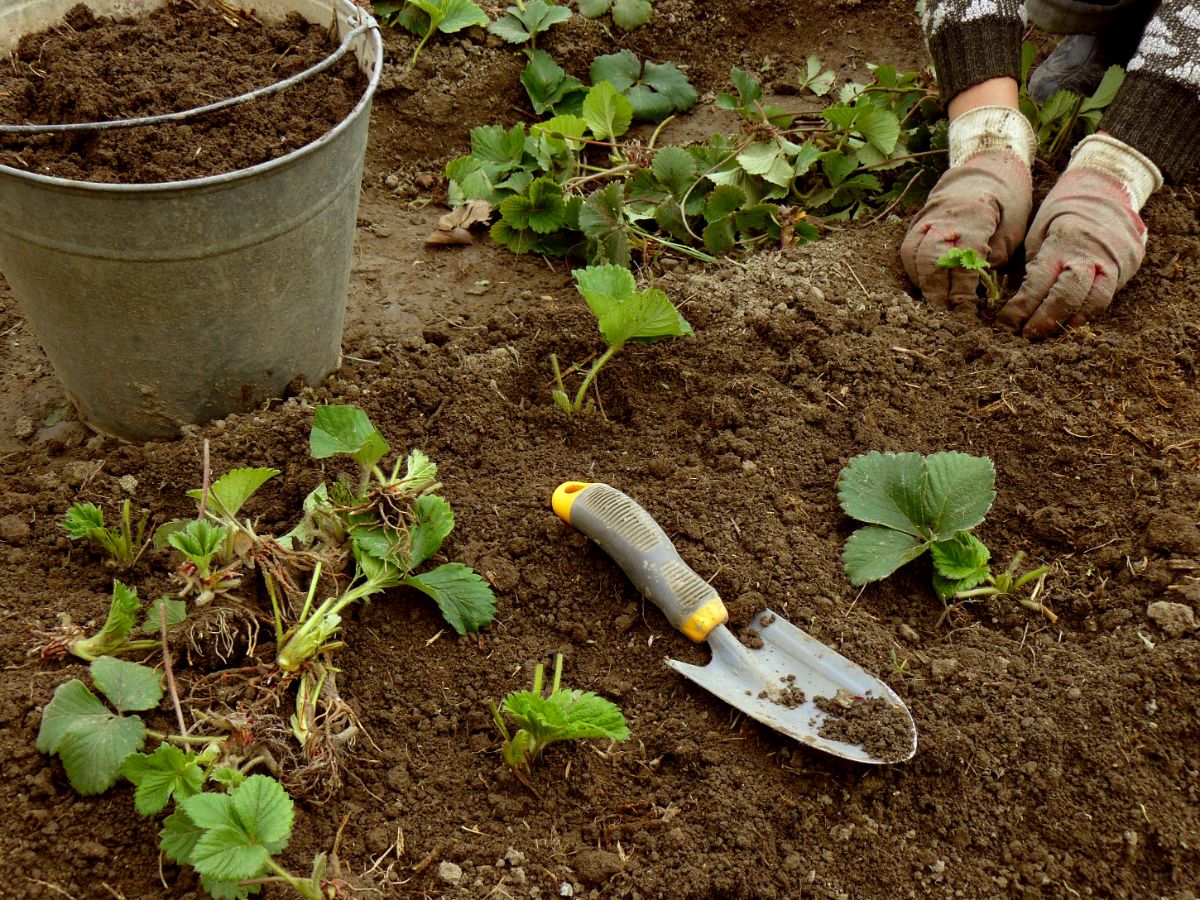
So, when should you transplant strawberry plants? If you purchase strawberry plants on the internet (see our directory of companies who offer Strawberry Plants for Sale Online or Buy Strawberry Plants by variety if you know which ones you want), you will likely be mailed the plants in the spring according to the recommended planting time for your hardiness zone. If you get them in the spring, put them in the ground as soon as possible.
As it takes a while for the plants to establish themselves, foregoing the smaller crop during the subsequent growing season after planting will provide much larger harvests in the following years (see the Growing Strawberries page for more details on removing flowers and runners).
If you already have an established bed, you should generally transplant strawberry runners that have already established themselves. Carefully digging up the younger plants should be done in the fall. Typically, late August is the best time to transplant for most of the zones in the United States. However, in the warmer zones of the south, transplanting can be done later. In the much cooler climates, transplanting strawberry runner plants can be done earlier.
By transplanting strawberry runner plants at this time (in late August), the yields obtained during the following growing season will be maximized. Remember, however, that strawberry plant transplants can grow successfully at just about any time during the growing season as long as they are well-watered and have a hospitable growing location, but transplanting them during the hot summer months takes its toll on the plant.
How to Transplant Strawberry Plants
It is important to know how to transplant strawberry plants correctly so that they aren’t unnecessarily damaged and the stress to the transplant plants is minimized.
To transplant:
- Prepare your new location first. Make sure it is hospitable, sunny, rich, sandy loam, well-drained with slightly acidic soil, generally well-suited for strawberry plants, and historically acceptable (see the Growing Strawberries page linked above for more on the best growing conditions and soil-history concerns).
- Select the strawberry plants you will be transplanting. Generally, it is best to transplant established, young runner plants that are only a few months old. Choose only strawberry plants that look healthy, and remove any flower buds, damaged or discolored leaves, and runners prior to transplanting.
- Obtain a substance or material that will hold moisture. Sphagnum or peat moss is probably best, but something as simple as wet paper towels is usually sufficient. It is very important to keep the roots of your transplant strawberries moist during the transplanting process.
- Dig up your selected and prepared runner plants (or other strawberry plants). Take care to remove as much of the strawberry plant’s roots as possible from the ground (so that most of the roots are attached to the plant). Once free of the ground, cover or wrap the roots with your moistened peat moss (or other selected moistener).
- Transplant strawberries to your new, prepared strawberry bed. Do not dig up all the selected strawberry plants at one time and then try to plant them all at one time. Transplant one strawberry plant at a time. After each plant is in the ground at its new location, water it thoroughly before transplanting the next selected strawberry plant. This minimizes stress and increases the probability of success. Waiting until all the plants are transplanted before watering all the transplants simultaneously with a sprinkler or other apparatus may cause unnecessary plant loss.
Transplanting Strawberries: Systems
To maintain the vigor and production of your strawberry plants, you may want to utilize a strawberry transplanting system. By transplanting strawberry plants to new strawberry beds each year, you can maintain three (or more) vigorous, well-producing beds. The steps below can be modified to allow the strawberry plants to fruit for additional years or fewer years as desired. By not transplanting each year, you can maintain the cycle with fewer strawberry beds.
Year 1: Transplant Strawberry Plants from Established Bed
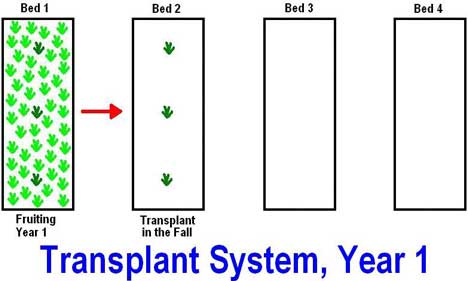
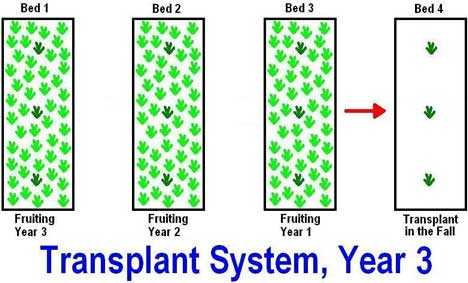
If you ordered strawberry plants online or bought them from a local nursery and planted them in the spring, the strawberry bed likely won’t be established and into “Fruiting Year 1” until the following spring. At the end of the first fruiting year (the first year of the strawberry transplanting cycle), transplant several of the healthy, well-established strawberry runner plants to a new bed (bed 2) in the fall. Take care of your beds and winterize them as described on the Growing Strawberries page (link above).
Year 2: Two Fruiting Strawberry Beds, Another Fall Transplant
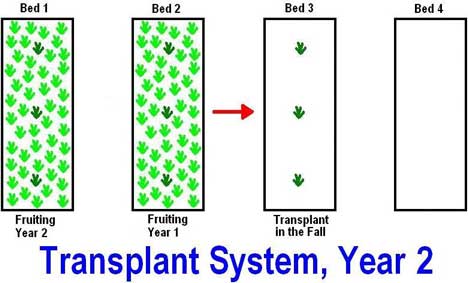
In year two of the system, the transplant strawberries in bed 2 will produce runners during their first fruiting year. The strawberry plants in bed 1should produce a good crop as the strawberry plants will be in their second fruiting year. You may need to thin the runner strawberry plants in bed 1 if they become too thick. In the fall, transplant strawberry runner plants from bed 2 to a new bed (bed 3). Overwinter all beds again.
Year 3: Three Producing Beds, Another Transplanting Strawberries Session
Bed 1 is now in its third production year. It is likely that these old plants will begin losing their productive capability soon. Beds 2 and 3 should also provide ample harvests. In the fall, transplanting strawberries occurs again. Following the same pattern, runner plants from bed 3 are transplanted into bed 4 in the fall. Also in the fall of year 3 after the strawberry plants in bed 1 have completely finished producing strawberries, they should all be removed. After removing, the renewal process should begin and continue into year 4.
Year 4: Renew the Bed Before Transplanting Strawberry Plants Again
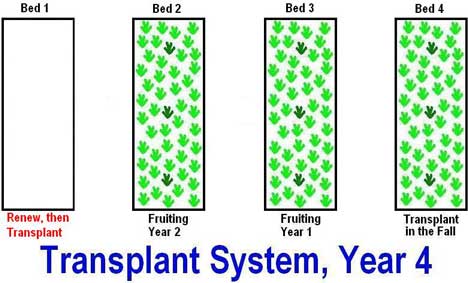
The strawberry plants in bed 1 should have been removed after they were completely done producing fruit in year 3. As soon as that occurred, bed renewal should begin. Rich organic compost, aged manure, or other soil enhancers should be generously added and tilled in. Either organic or non-organic fertilizers can be added as well. Add rich organic matter 2-3 more times over the course of the spring and summer months of year 4. In year 4, beds 2, 3, and 4 will produce a harvest while bed 1 is being renewed. In the fall of year 4, transplant healthy runner plants from bed 4 back to bed 1.
As long as your plants remain disease-free, this system should provide ample harvests from three beds from strawberry plants in their prime production years. By replanting in the same beds, you do have an increased risk of your strawberry plants succumbing to one of the various strawberry plant diseases (reference the Strawberry Plant page at the link above for more details).
Once the transplant runner plants are in bed 1 again, the cycle restarts. Barring disease and assuming sufficient nutrients are re-introduced and combined with the soil to properly nourish growing strawberry plants, this system should theoretically sustain a 3-bed berry harvest indefinitely. The size of the beds are limited only by the gardener’s ability to maintain them!
Transplanting Strawberry Plants: Conclusion
Hopefully this guide to strawberry plant transplanting has helped you. You should now know why you should transplant strawberry plants, when you should transplant strawberry plants, how you should transplant strawberry plants, and that it is usually best to transplant strawberry runner plants that are young and healthy. If you need extra help remembering which plants are old and which are runners within a bed, you can always use the cheap white plastic label stakes or Popsicle sticks to mark individual strawberry plants.
Hopefully, the strawberry transplanting system described will help accomplish your strawberry-producing goals as well. Good luck, and happy transplanting!




Ashley says
Hi! So. I’m in zone 6 in Detroit and I have a bed that was taken over by my strawberries in the last 2-3 years. It’s overcrowded and they desperately need to be transplanted because I can’t take care of them properly and i need most of the bed for other plants and to amend the soil. I finally received my greenstalk but now the plants are all flowering and I’m almost terrified to proceed to transplant them. What is the best move for me here?
Mary Ward says
If you need to move them, you need to move them. I would pinch off the flowers and transplant, and then keep them well watered until rooted. If you can wait until after the harvest, you won’t have lost much but if it can’t wait, go ahead with it now.
Cynthia Humm says
I have plants in a container that I want to overwinter. Can I move it into our cool but not cold basement pantry or should it go into a freezing shed? I live in zone 3 so it does get to -32C often and even -40C at times. There is never clear directions on this. When should I move it, should I water it or should it be mostly dry, how do I treat it throughout the winter.
Mary Ward says
In your zone and conditions I would opt for the cool basement–but make sure the pot doesn’t dry out. Not constantly watered, but not dry and dusty.
Elaine says
Thank you for so much information. What I’m trying to figure out is why there are soooo many configurations for growing strawberries, like towers, pyramids, and many vertical methods. How does this type of growing work when the plant makes runners. I’m thinking these vertical planters are used because of the runners but I just don’t know. Can you explain please and do you recommend?
Dave says
My strawberry plants only put out runners. I kept cutting them off, but they just kept putting out runners. Out of 50 plants I got maybe 50 berries. Some of the plants didn’t make any berries. Beautiful plants, but NO BERRIES.
Laura Lokken says
I neglected to do the research before I moved an established strawberry plant and moved it earlier this spring during an extended stretch if warmer weather. I dug out the entire root system and moved the plant to a raised bed. I divided it into smaller plants and put them amongst my established pineberries. They all seem to be well rooted in the raised bed at this point and are blossoming. Should I remove the blossoms or let them develop into strawberries?
Jennifer L Duncan says
I have resendly purchased a few strawberry plants and one of them has fruit on them. Is it ok to plant it with the other plants?
David says
I am in Montana – zone 5b. It is Nov 21st. Is it too late to transplant my strawberries? I put about 12 plants in a raised bed this year. My first year of gardening. That bed got full of weeds and grass this year as we were gone for a month. Bad timing. I am wondering if now is too late to uproot these strawberries and transfer to a different bed that i prepared already. Or should i wait until spring to transplant? Thanks for your help.
Bonny says
Hi, I live in Idaho Falls, Idaho. I planted two strawberry plants in a sheet mulched gardening spot and they have expanded to fill a 5’x 6′ garden bed. I really did not know about transplanting the new runners and changing out beds and things like that. I would pull them up and get rid of them when they expanded out of the basic borders of the bedding area. This was at least 6 years ago. I have never really had a huge amount of strawberries. This year it is better as we have had lots of rain.
I also am very careful to heavily mulch my garden beds in the fall with grass and leaf mulch from the lawn mowing company and some years I also add dried steer manure and once I added some chicken ( dried manure) from Wal-Mart.
A couple of years ago, a friend also shared some plants from her strawberry bed as well. I had no idea that a person was supposed to pull out old plants altogether and to put the new runners into the bed. I have always pulled anything out that looked old or yellow, etc. Now, I need to understand what to do with my bed as I know that it needs to be thinned out and to have older plants pulled out. Everyone has always remarked on how healthy and huge my plants are, flowers and or fruits.
What would be your advice on how to re-do my strawberry bed? I really only have this one spot to grow them at. The other smaller flower bed is too dark and wet as a huge tree overgrows the yard at my complex.
I would appreciate any counsel you could give to me ( I am also going to be giving plants to a friends as well and from what your advice says, I need to wait until fall and to put planters/pots out for the new runners that come to root into.)
Thanks so much, Bonny
Jennifer Proude says
Hi Bonnie,
Your plants may have too many runners. They can be very hard to see but if you look along the ground you should find them.
Basically strawberries put out daughter plants (runners) and thats ok, but once the daughter plants establish roots they should be clipped or they will also put out daughter plants. Then it becomes too much and the original plant, so it has to put its resources into keeping the daughter and granddaughter plants alive rather then bear fruit.
Ruth says
I live in south central Kansas and wish to transplant some of my existing strawberrys. Some have already made runners and others have not. When is the best time to transplant them into one of my existing gardening beds? My raised garden beds are 4 x 8 and are about 2 1/2 feet off the ground. Do I need to be mulching the strawberry plants for the winter?
Joanne z miller says
Can I transplant runners that have not rooted in soil? Do they have to remain attached to mother plant until rooted in soil. Or are little root nubs ok to take from mother plant and place in soil?
Bebe says
I had no problem clipping runners with only little root nubs. I just paid close attention to keeping them watered in the new bed until they established roots. I kept them from making any more runners themselves (or flowers) till they grew for a season. They seem very hardy, from my experience. And I had no idea they would get so huge in only a year and have so many developing berries. I hope you had good luck!
Gwen says
I live in Louisiana I purchased 9 Strawberry (3 Ozark Beauty, 3 Alstars, and 3 Quinnalts) plants from a local store. Some already had little Strawberries on them but since have died. I have them grouped together they are in a well sunny area and get well moistured but my problem is that they uave been planted for queit some time about a month if not longer should they be producing strawberries by now. If so what can i do diffferent. I have then planted in the groud.
jeanne radke says
see the article above I believe says thec1st year take off blossoms. Read needs for transplanting and soil amendment.
Janet says
I see transplanting is best in the fall but can it be done while thinning in the spring as soon as they come up?
Tarina says
Sorry if this question was posted already.
I have a small vegetable garden that we have composting pipes in. I guess some of the strawberry seeds from scraps germinated in the garden bed as a result.
I live in Michigan and am wondering if I can transplant the strawberry plants now before they start flowering, or if that would damage them? I am planning to put them in a fence wall/pallet planter.
Thank you!
Laura says
Hi Mr. Strawberry,
I live in Ireland. I put down little pots for runners from my strawberries a few weeks ago. (The original plants are now in their 2nd year). They’ve rooted very well and look healthy. Some of these recently rooted runners have already put out their own runners! Should I root these newest runners or cut them off?
Thanks,Laura
Mr. Strawberry says
Laura,
It depends on your space. You don’t want to let more than 3 plants root per square foot or so. So, if you have more than that, you should either snip them off or transplant them to a different area. Good luck!
Maria says
Hi Mr Strawberry
I have purchased 2 very healthy looking plants currently bearing fruit in a hanging basket.
I want to plant them in a previously successful strawberry patch that is now defunct as we didnt know anything about strawberries when we moved in 4 years ago and also the dogs ran all over it.So I would like to redeem myself in the strawberry world!
It is a very rainy summer here in Scotland so far but a fair amount of sun too.
When should I transplant them to the ground please?
thanks maria
Mr. Strawberry says
Maria,
The best time to transplant is toward the end of September. Good luck!
aUDREY fENDELET says
HELLO MR STRAWBERRY. I live in mid Saskatchewan Canada and I always read that you say to transplant in the fall. My plants would never ‘root down’ and winter kill for sure if I did this……….HELP, our winters can go to -40 in the winter here. I am on a two yr old patch and its the first week in July, can I transplant my well rooted baby plants to Bed #2 now. Then next yr do the same into Bed #3??? Etc Etc. Thank you sooooooooooooooo much in advance, Audrey
Mr. Strawberry says
aUDREY fENDELET,
In more moderate climates, planting in September gives the plants plenty of time to root. You should probably transplant no later than August in your location. July should be fine to transplant also! Good luck!
Miranda says
Hi there! Thank you for sharing all this wonderful information. I planted approximately 50 plants last year and am wanting to transplant them all, not just the runners to thin but to have a whole new bed as the location they are currently in is not ideal and I did not properly prepare the area I planted them in due to lack of knowledge at the time. Will I be able to save and transplant the whole plants to a new area? Or should I just start over in the new area?
Mr. Strawberry says
Miranda,
Yes, you should be able to transplant all of them. Just make sure that they have enough space! Good luck!
Miranda says
Thank you so much! I’ll give it a go, the area I want to move them to is very large and much more suitable for them. I appreciate your quick response and advice!
Leti says
I love this explanation. very easy to understand but my problem i’d have in my backyard is space. what do you recommend when space is a problem. my strawberry bed is about 2.5 ft by 20 ft. How do you transplant on a space like this??
Thank you
Mr. Strawberry says
Leti,
To modify this system, just set aside a portion of your bed to lie fallow each year and be amended at that time instead of transplanting to a completely different strawberry bed. Good luck!
Jinny says
Hi,
I need a little clarification —
In the Spring I plant purchased strawberry plants. I do not transplant runners until the Fall of the next year. Is this correct? Or am I transplanting them in the Fall of the year that I planted the purchased strawberry plants?
Also, if I plant 500 strawberry plants, approximately how many runners might I be looking at to transplant? One (or possible how many more) from each plant?
Also, re. the purchased plants, will they produce fruit in the first year? I am wondering how market gardeners handle that first year (where picking all the flowers would be impossible – what do THEY do?)
Thank you for your time.
Jinny
Mr. Strawberry says
Jinny,
If you plant your strawberry plants in the spring, you will transplant the runners in that same year, about 6 months later or so. If you transplanted every single runner from 500 healthy strawberry plants, you could be looking at anywhere from 1,500 to 3,000 new plants to transplant, depending on the health of the plants and the variety you planted. Purchased plants will often produce several strawberries during the first year. However, the subsequent year’s harvest will be negatively affected by allowing the plants to set the fruit instead of using their energy to grow as plants and grow their roots. Most strawberry farmers that sell commercially use the plasitculture method or anther that allows them to grow strawberries as annuals instead of perennials. Good luck!
Helen Zaayenga says
I am zone 6B and would like to share my Rutgers Strawberry runners with a friend. It will be in the mid 50’s all week, nights hovering just above freezing. Can these still be transplanted this year? Thank you, Helen
Mr. Strawberry says
Helen Zaayenga,
Yes, but hurry! The longer you wait, the more likely it is that the plants may not make it. Good luck!
Tiff says
Thanks for all the great information on your site. Who knew I was doing so many things wrong??? 🙂 We started our strawberry patch in spring 2013 with some plants (unknown varieties) dug up from my mom’s garden and it’s never been mowed, fertilized or had the runners removed. (Oops.) We get mostly small (but really good tasting) berries in June (definitely more last season than this one), and a few more over the course of the summer but the texture of the later berries always seems really soft (they may be an entirely different variety too). We’re four seasons in and I’m guessing it’s probably time for me to move my plants to a new location. Should I do that now (we haven’t had our first frost and it’s not in the forecast yet…zone 5 I think?) or wait and do it in the spring? Or, leave them where they’re at for another season and go out now and just deal with some of the overcrowding? I guess it wouldn’t hurt to try to plant any that I remove into a new area. I have a lot of well-aged, sandy chicken manure (we use sand in our coop and run) that would probably work to amend the new space. Any thoughts on how you think I ought to proceed? Thanks!!!
Mr. Strawberry says
Tiff,
Now is a great time to transplant if you think you can transplant runners that were new this year. You don’t want to transplant the over 3-year-old plants, but transplanting the runners that rooted this year is a good idea. Also, amending with the well-aged manure will do great (as long as there isn’t too much nitrogen in it) for your plants if it drains well (it should with the sand). It sounds like you are on the right track! Good luck!
Teija says
I tried strawberries in a raised bed and gave them mel’s mix and everything I read about. But I mostly got leaves.( And a wonderful crop of Bermuda. Now, I would like to try again. I live in NW Arkanas Zone 7. I am interested in the Ruth Stout method. I have read her books, and for the life of me, I cannot understand her rotation method for strawberries. Can you help? Also, What kind would you recommend for me in my area?
Mr. Strawberry says
Teija,
Ruth Stout’s method seems to work for some people, but most people still have significant issues with weeds using the hay mulch. Similar to the Back to Eden method, the real-world reports of people who try it tend to be more ambivalent than enthusiastic once a year or two has passed. If you have a well-manicured area that you are turning into a garden, or if you use all sterile soil to begin, the weeds can be kept at a minimum. However, if you start in an untreated yard or field (like most folks do), you end up with weeds and a significant time requirement to get things running smoothly (and keep them running smoothly). My own opinion is that the transplanting system described on this page is both the easiest to maintain and the one that will give the best results. It isn’t incompatible with Ruth Stout’s method of hay mulching OR the other mulching systems, but it does leave one area or bed fallow at a time to allow for restoration/renovation. Whichever way you go, though, good luck! And, see this for the recommended varieties for Arkansas.
Sonali says
Hello i habe a question, when do you lnow of your strawberry plant is dead or dormant? I have some in the same earthbox and some
Look dead and others are ok and flowering but before i pull them out i wanted to know if they are dead or dormant they are all brown and no leaves
Mr. Strawberry says
Sonali,
If adjacent plants are flowering, the ones that are brown are dead. I’m sorry!
maya says
I live in Minnesota. Is it too late to transplant runners? Should I plan on doing it in the early spring? Should I just thin the strawberries I have?
Mr. Strawberry says
maya,
No, it isn’t too late! Go ahead and transplant them as soon as possible! Good luck!
heather says
My issue is that about 10 yrs ago, I planted 50 ever bearing strawberry plants—I think they were Quinault. Over the years, I’ve thinned them out on occasion and snipped off runners. Now, I have about 300 strawberry plants that are way overcrowded and haven’t produced much of anything (I think we got about 10 strawberries this year). I’m also growing blueberries (in another bed, about 200’ away) and did a soil test because the blueberries were not doing well. Everything was either “neutral” or “low” in my soil. I bought some amendments and fertilizer and the blueberries look great. I’m wondering if beyond majorly thinning my strawberries—if adding fertilizing would help? Also—pretty much all of my plants are “old” and well-established. Would they survive a transplant, if I did it in the fall? Or should I just dig them up and toss them?
Mr. Strawberry says
heather,
If your plants are 10 years old, I’d recommend replacing them. Diminished soil nutrition will greatly impair production, but old plants will have declining (or non-existent) production even with perfect soil. If you have the space, you may want to adopt a transplanting system to keep things humming along year after year. Good luck!
Twyla S says
Mr. Strawberry
I just found your site and I thoroughly enjoyed reading your advice. I have an older straw
berry bed and am in need of transplanting. I live in Minnesota so will wait till later August to do my transplanting. Thanks for the advice.
Mr. Strawberry says
Twyla S,
Thank you for the kind words, and good luck!
Debbie says
Hi Mr. Strawberry
We moved on to our land 8 years ago, and planted 6 strawberry plants that year. The location was ideal, and we have had many good harvests – last year (year 7 for our plants) was the best harvest EVER! I would like to move the patch, due to construction of our greenhouse. Would it harm my plants to move them from in-ground to a raised bed? We’re getting older, and bending over to harvest is not as easy as it once was! We live in north central Indiana, and my concern is that they will get too cold in the winter in a raised bed, killing my plants. I just found your website today and love all the strawberry advice!
Thank you 🙂
Mr. Strawberry says
Debbie,
It may take more effort and insulation during the winter to keep your plants alive if temperatures plummet. However, you should be able to transplant them as long as you are careful with the roots. Good luck, and thanks for the kind words!
Claudia says
As to construction I no longer have room for my strawberry plants. I live in northern OH. When I was in Florida I saw stacked pots with pvc pipes for watering. Can I do this up north and if so how can I maintain the plants over the winter and when can they be moved to the pots. Thank you
Mr. Strawberry says
Claudia,
Yes, you can use a system like that where you live, but you’ll either need to insulate/wrap them well outside or bring them into a sheltered area, like a garage, to overwinter them. As soon as the adventitious root tip on the end of the runner has established a root system from a mother plant, the runners can be snipped and transplanted anywhere you’d like to move them. If you are talking about moving already-established plants, go ahead and move them now. Just try to keep as much of the roots intact and undisturbed as possible. Good luck!
Steve B says
I want to rearrange my strawberries as the havery moved to the bottom of the planter box and have LOTS of runners. I live in Maine. Can I rearrange and transplant into a new planter box in the spring and still be ok? It’s mid October and getting very chilly now. Is it to late to do it now?
Mr. Strawberry says
Steve B,
I’d recommend waiting until spring. Good luck!
Connie B says
Mr. Strawberry its April and about 60 degrees in Idaho. I have several strawberry plants growing in tires but I just built a new raised bed to put them in! They produced beautifully last year and have established many more plants. The tires have garbage bag on the inside so i feel like it would be very easy to pick up, place in the bed, and then remove to plastic underneath without disturbing the plant or the root system. Is that a good idea or should I just wait until fall?
Mr. Strawberry says
Connie B,
Since most of the strawberry roots are in the top few inches of soil, you should be able to move them like you mentioned without much difficulty. Good luck!
Sheboygan Bert says
Sylvia, when putting s.b. plants in your temp containers, make sure they get watered daily and keep them out of the sun. I’ve dug mine out in early April, kept them under a dense evergreen which offered 100% shade, and then replanted the s.b. in late June, and they survived, although, no berries this year as for some reason they didn’t, lack of sun. When replanting, I trimmed some of the roots and all of the long leafs and any leafs with spots or pieces missing, leaving a few short leafs and the main-leaf-bit which puts out the next new growth, important keep that bit above the soil line of the plant will suffocate/rot. My s.b.’s are the alpine everbearing type, most favored: “Fraise” from Hirts.com
CyndiK says
For the purposes of transplanting into box #2 this fall, are runners from box #1 the only ones we should consider? We transplanted from a long overgrown plot last year into box #1 and they are now producing runners. But “volunteers” from that plot are coming up now, so although they are new plants, they are coming from old roots. Is it best to just dispose of the volunteers and transplant only the newest runners?
Mr. Strawberry says
CyndiK,
It is best to use new runners. Good luck!
HANNAH says
So I planted a strawberry plant last summer in a pot, and this summer its doing great and spreading out everywhere, So I finally got myself a garden box for my strawberries to start a strawberry patch. Its in July now and I’m wondering if I move the plant now will it hurt the plant? or should I just wait til next year? I live in Ohio.
Mr. Strawberry says
HANNAH,
If there is no rush, I’d wait until the end of September and transplant it them. Good luck!
terry says
my strawberry bed has lots of vine weed. I would like to salvage some runners, treat the bed with round up and then replant the runners. when would be the best time to do this?
Mr. Strawberry says
terry,
I am not sure. Roundup binds pretty firmly to soil, so I don’t know how long it would take for the Roundup to break down and make the plot safe for strawberries again. I’m sorry!
Dale says
I only have one bed for strawberries. Is there a way to identify the older plants that are mixed in with newer plants. I’m doing everbearing.
Mr. Strawberry says
Dale,
The older the plant, the larger the crown usually will be. So, to figure out which are likely the oldest, see which ones have the biggest crowns. Good luck!
Sean Dougherty says
Hi Mr. Strawberry, A local “pick your own” strawberry farm gave away all of their strawberry plants as long as you dig them up. A friend was kind enough to get me a large tub of the plants. Today I snipped about 200 runners and put them in small dixie cups with potting mix. It is 95 degrees here in Burgaw, NC this week. Do you think my runners will be ok outside in the dixie cups until fall when I can plant in my garden or would I be better off putting them in the ground now? Thank you so much for the excellent website!
Mr. Strawberry says
Sean Dougherty,
It would be better to plant them now. It will stress them with the heat, but it will stress them just as much in the cups. If the runners were snipped before the roots of the node plants have established themselves into the soil, they will probably die regardless of what is done. But, I’d recommend planting them as soon as possible. Good luck!
Brian says
i just planted 10 strawberry plants about a month ago in ohio,they are taking off and doing great sending out runners,the prob i just realized was the bed i placed over top where we removed the yucca plant that was there,and it is starting to come back,yucca is a bit more hard to get rid of than i thought. would it be ok to move the plants now or should i wait until fall? as i would hate for the yucca to come up through the patch when it comes in.
Mr. Strawberry says
Brian,
If you can wait, it is usually best to transplant once the weather has started to cool just a bit. The scorching summer heat makes transplanting a bit more traumatic on the plants, but they can survive it. Good luck!
Ron says
Last year we transplanted some strawberries to 4 new raised beds. All plants grew well & even produced lots. This year we do not see any growth from the dormant plants that were moved last year. Will they come back, or do we need to plant new strawberries? Thanks for your help. Ron
Mr. Strawberry says
Ron,
At this point in the year, if there is not any new growth, the plants are likely dead. Replanting is likely the best option, but it would be advisable to determine what killed the plants first so that you can remedy the problem so the new plants don’t follow the old into the netherworld. Good luck!
Robin says
Due to a fence being placed in my neighbours asked me to remove a strawberry plant of unknown type that they no longer wanted. I’ve done this however it had berries and flowers still active on it – should I remove these or leave them on and see what happens?
Mr. Strawberry says
Robin,
At this point, I’d remove them to help the roots re-establish in the plant’s new location. Good luck!
hailey says
I couldn’t find any strawberry plants so i bought hanging baskets and want to transplant them into my garden. I just want to know if there is anything special I need to do. When i googled transplanting I couldn’t find anything from basket to garden. thanks for any advice
Mr. Strawberry says
hailey,
You transplant from a basket just as you would from one ground location to another. Good luck!
sylvia says
we have to move and we were hoping to dig up our 200 strawberry plants and put them in containers until we can put them into the ground when we get where we are going. is that possible?
Mr. Strawberry says
sylvia,
Absolutely! Just make sure you get as much of the established root system as possible, re-plant them as soon as possible on arrival, and water them in well. Good luck!
Joe says
I’m about to transplant all of my garden strawberries, young runners as well as established plants to pots that will stay in a heated greenhouse for the spring. I’m wondering if this is the best time to do it? It is late march in NJ and Half of the garden is still frozen so I would only do half this week and the rest as soon as I thaws… Is this an okay time to transplant? Also will it be shocking for them to go from nearly frozen ground to pots in a heated greenhouse? Will I get any strawberries from them this year? Thanks, joe
Mr. Strawberry says
Joe,
It will stress the plants a bit to transplant them. If the plants are dormant, I’d go ahead and try to transplant them as soon as possible. Overall, they should do okay, and, if they aren’t traumatized too much during transplanting, you should still get fruit. Good luck!