





Have you ever seen those hideous, misshaped strawberries? If so, you might have wondered what causes deformed strawberries to be that way. Well, Strawberry Plants .org is dedicated to bringing light to all things related to the strawberry plant. And, unfortunately, deformed strawberries are a fact of life.
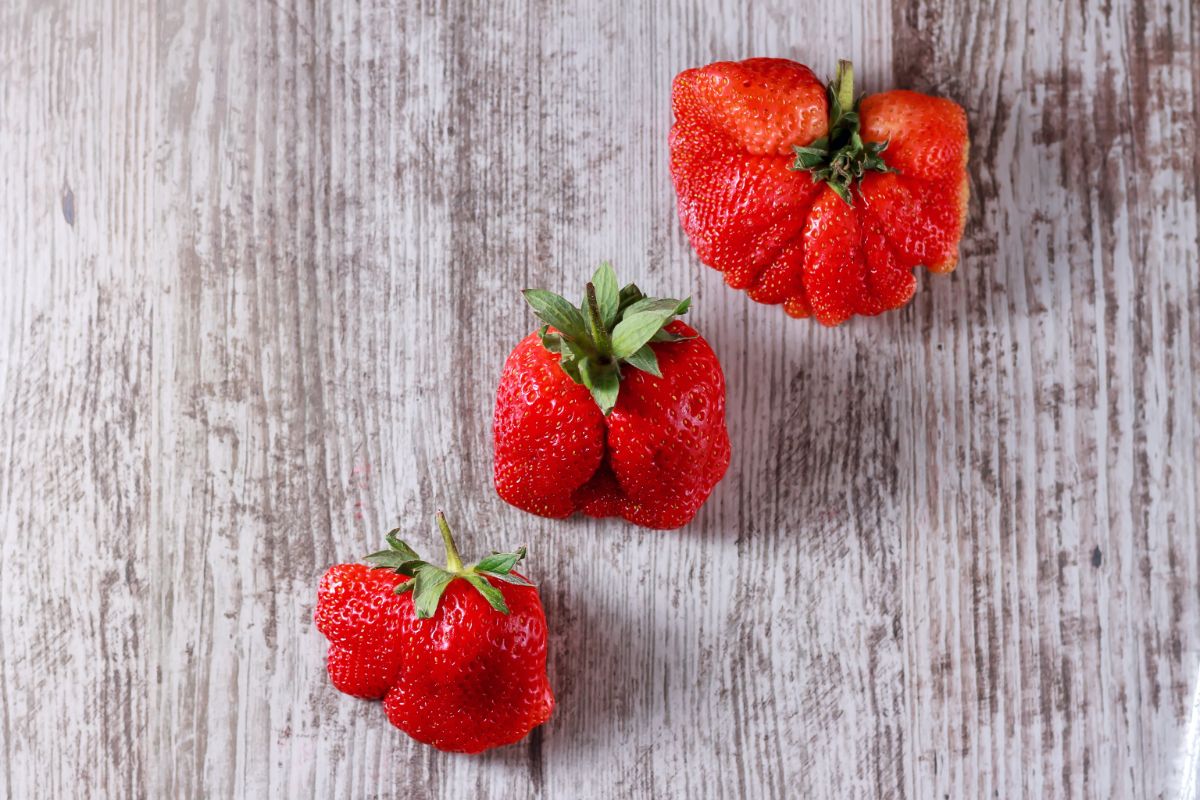
Hopefully, with the information contained within this post, you will never have to deal with your own mutant strawberries. Who wants to eat hideous fruit when nice, red, symmetrical fruit can be had? But, if you find yourself out in the strawberry bed picking your own deformed strawberries, here is what you need to know:
Jump to:
What Are Deformed Strawberries Called?
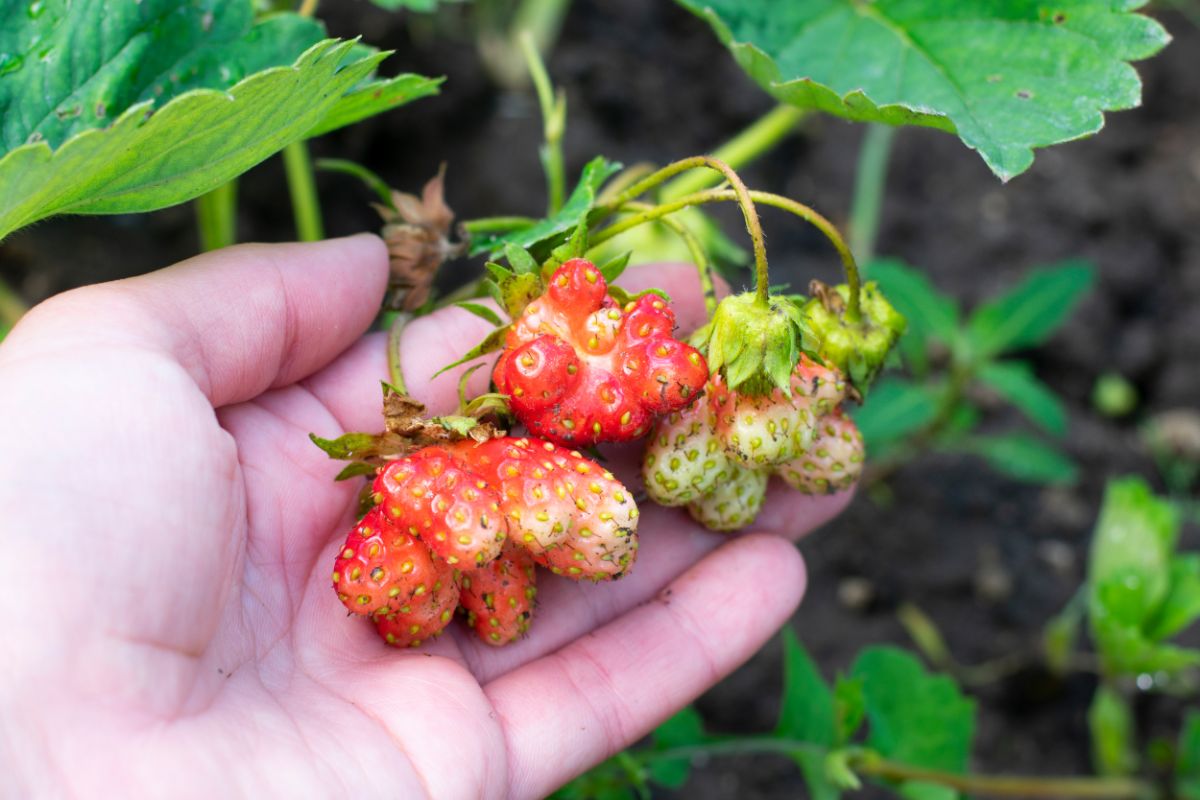
There are different names for a deformed strawberry. The most common two names for such berries are “nubbins” and “button berries.” Of course, the more generic adjectives are also often applied: mutant strawberries, deformed strawberries, runt strawberries, monster strawberries, etc.
What Causes Deformed Strawberries?
There are two main types of misshapened strawberries. The nubbins and button berries are the first type. The second type is referred to as cockscomb strawberries or fasciated strawberries. Each type of deformity is caused by different agents and can be lumped together in general groups. The button strawberries or nubbins are caused by external damaging agents, while the other deformities are more benign.
Nubbins and button strawberries are caused by external, usually damaging agents. Feeding by tarnished plant bugs or certain types of mites will cause them. Cold injury (specifically frost damage to the pistillate part of the flower) and nutrient deficiencies (particularly a lack of calcium or boron) will cause deformed strawberries to form. Additionally, inadequate pollination can result in poorly formed strawberries. Another cause for the formation of nubbins is very hot temperatures (the high temperatures damage the pollen viability). And, lastly, the application of the 2,4-D amine formulated weed killer (Amine 4), which is commonly used in the first step of traditional strawberry renovation, can cause deformed berries if sprayed while fruit buds are forming during the months of August and September.
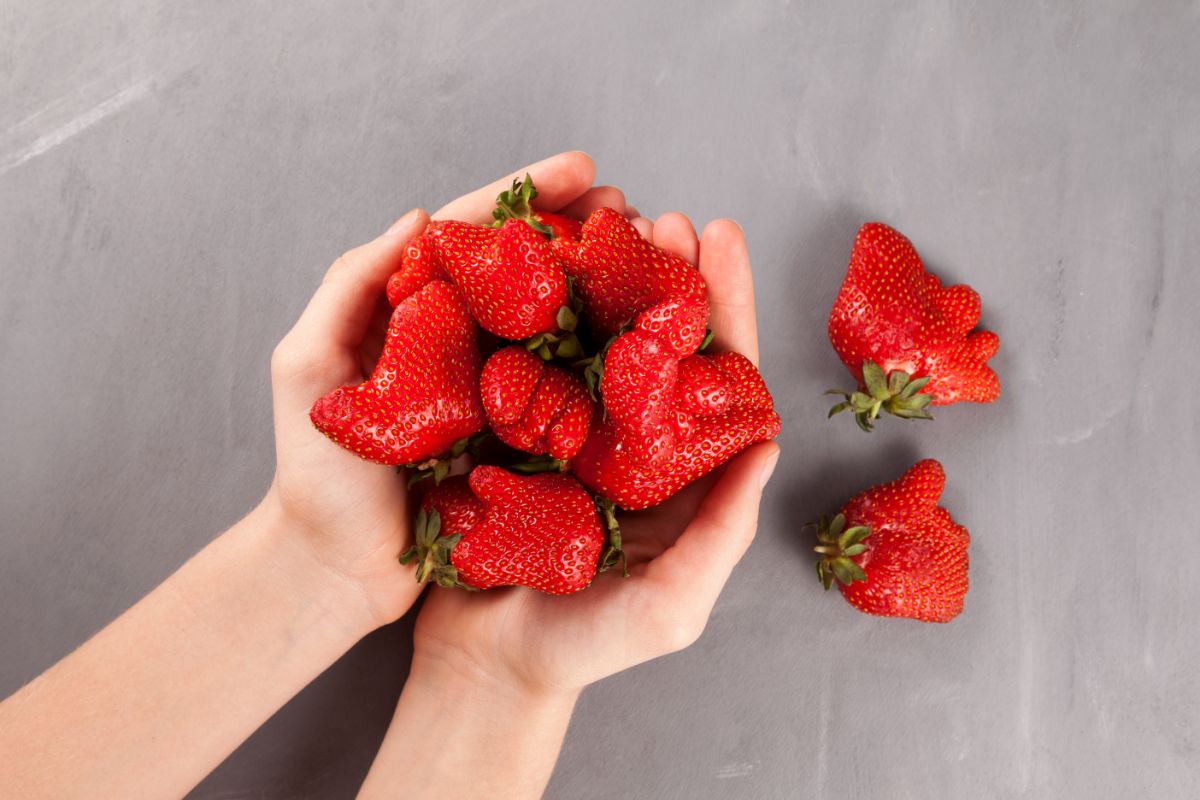
The other type of deformed strawberries have a cockscomb or fasciated appearance, hence their name. Fasciated strawberries and cockscomb strawberries look like several strawberries have fused and grown together as a single fruit with multiple points. This deformity is usually caused by either short daylight intervals or cold, dry weather during the fall. Often, the deformed strawberries are produced on strawberry plants when varieties developed and adapted for northern growing are instead grown in southern regions.
Deformed Strawberries: Conclusion
No one wants to grow deformed strawberries. But, occasionally, the dream of harvesting bushels of bright red, perfectly-shaped strawberries dies a cruel death on the rocks of reality. If you find yourself plucking puny and puckered fruits, evaluate the conditions in which the strawberries are grown. You may have a pest infestation or soil deficiencies. Or, you may have simply planted a cultivar that is ill-suited to your location. For each problem, there are usually steps that can be taken to remedy the problem that is causing your deformed strawberries. A good place to begin for information on successful strawberry cultivation is the Growing Strawberries page.

Debbie Schooley says
I have some everbearing ( day neutral? ) berries. They bear nice big berries in June. In summer, many of them do not fill out. The bottoms are green and hard and they are smaller and deformed shapes. I water them regularly. The weather here has been in the high 80s the past month, so maybe that is a factor.
Brett Kleinhans says
Hi. Love the info here. I was given 10 plants last year Sept (beginning of spring here in Port Elizabeth. South Africa). It’s now June (middle of winter). Temp varies from 7’C at night to average of about 21’C during the day. It’s been a mild winter so far. I’ve got no idea what variety I have. I decided to get a bit of a plantation going as we live on a small holding. I now have over 1000 plants! Yes the really did multiply by 100 per plant. Plants are mostly older than 4 months old. And they are now flowering quite excessively. The look very healthy with very good foliage. I’ve harvested a few already. There are literally 2-3k flowers/ strawberries. My questions are: 1. Do I have an everbearing variety? 2. Should I be pinching off the flowers? Thanks, Brett
Kristi says
I love my little strawberry plant. It’s in a Tara cotta pot…foliage looks good except for the occasional leaves turning orangish yellow. The first strawberries it produced were tiny but very sweet and yummy. Now there are dozens showing up. But I have one flower that looks like it’s trying to grow 3 or 4 berries out of it. It and tally looks like a little birdie. Two parts of the berries are turning red so far but they are smoother than the other berries on that he plant. I know that sounds wierd but I’m wondering if it will be edible when fully ripe?
Hello says
Should I cut off the runners and first blooms? Also I am worried about insect ifastations and the like. Can you help me? I really want new plants, but it says that I should cut the first flowers and runners off.
Ms. Appletree says
Hello. I am eating my strawberries and it seems to have green seeds, and the tip of the berrie is sort of smushed. Can i eat it?
Mr. Strawberry says
Ms. Appletree,
If the strawberry is discolored, it is best not to eat it. Good luck!
Angie says
I have some strawberries that are not doing well. They are deformed, but don’t seem to be like the examples shown. The seeds leave pock marks in the berries and they don’t fill out correctly. Someone suggested that it could possibly be some type of virus causing it. Here is an example of the berries.
Mr. Strawberry says
Angie,
Some strawberry varieties will naturally look like that. Do you remember which varieties you planted?
Kathryn M Bell says
I live in Central Oregon at about 4,200 ft. We have had a very hot summer in the 90’s to 100 degree days and no freezing nights this year. However, my strawberries have developed little brown spines on the berry. They are prickly enough that you can’t eat them. Some berries have them and some don’t on the same plant ? They are watered well. Is this caused by the heat or the sun ?
Mr. Strawberry says
Kathryn M Bell,
No, exposure to the sun won’t cause spines to form on the berries. They may be egg castings from an insect. Can you send a picture?
Rich says
Our strawberries have been a disaster this year, which was our first attempt. Every fruit is small and deformed. We are in northern Virginia where we have 80-90 degree temperatures pretty consistently. Is it likely to be the heat? The soil is mostly miracle grow fruit&veg and we water pretty regularly. Any thoughts? We planted in April/may, its now July and the plants have really struggled.
Mr. Strawberry says
Rich,
This might help. Good luck!
Jim ranson says
Just a quick inquiry .. I have been growing strawbs for some time and have had great results especially after feeding the soil ..I have recently liberally used alpaca poop and the crop has been astonishing in terms of size and quantity … there have been some very large fan shaped fruits almost touching either end .. is this deformed or is is super-growth ? ..
Mr. Strawberry says
Jim ranson,
No, those are not deformed, just really big strawberries! Good luck!
karen brzozka says
My strawberries are growing really well in a raised bed. Large strawberries that have ripened but have two tips that are green! Any ideas ? Look really suggestive !!
Mr. Strawberry says
karen brzozka,
The tips of the strawberries are the last part to ripen. If you give them another day or three, they will likely redden like the rest of the berry. Sometimes, however, they hold out. If the rest of the strawberry starts to get soft or over-ripe, go ahead and pick the affected berries and just slice off the hard green/white tip. Good luck!
nancy says
My strawberries are not only deformed, they are soft and squishy. Any thoughts as to why?
Mr. Strawberry says
nancy,
The two most common reasons for soft and squishy strawberries are them being over-ripe or starting to rot after insect or animal damage. Good luck!
John says
I have these mutant strawberries. They look quite whole and healthy and are a great cause of amusement when I show them to people. However they have a wonderful taste and are lovely and sweet. They are also prolific. I have other normal straws’ too, English varieties – is there any other kind worth having, I hate those dark red gargantuan Spanish ones. They’re hard and often sour or bitter. Give me the sweet Frankenstein ones, one of which I found wild in my tiny garden two years ago. It throws out lots of runners so not hard to grow.
Tim says
Do you know of any organic ways to get rid of my tarnish bugs?
Mr. Strawberry says
Tim,
You can try a liberal sprinkling of diatomaceous earth. Good luck!
Rudi says
How do you plant the little baby plant that grows from a mature strawberry? Do you just put them into the soil as is or do you have to put them in water first to form roots?
Mr. Strawberry says
Rudi,
If you have already germinated the seeds, yes, just plant them in the fertile soil. If they haven’t yet germinated, this can help. Good luck!
Deb Clark says
Just stick them into the soil and they will root.
Louise Krekic says
I planted Tristar everberries and was told at the nursery that those are the top strawberries. I planted them in a composted patch, enough water and sun, they are between a peach tree and a nectarine tree. They are facing South so they might be a bit too hot. All the fruit is delicious and juicy but in a shape of a button mushroom. What could be wrong ? Last summer was cooler than this summer, but I always water them and make sure the soil is damp. No weeds, they are in round patch. Did this ever happen to you ?
Mr. Strawberry says
Louise Krekic,
No, I’ve never had that happen to me. If there are no signs of damage/insect feeding, and the strawberries still taste normal, I wouldn’t worry about it too much! They might be shaped that way due to the specific composition of soil minerals/nutrients. You may want to have your soil tested just in case. Good luck!
catie says
Thus is my first berry plant…and it looks like they have big green warts on them…right after the flower starts to fruit…..what’s that about??
Mr. Strawberry says
catie,
I’m not sure what that would be. I’m sorry!
Nancy says
i planted new plants from a nursery last year. Plants look healthy but all berries are deformed. Some blossoms look dried out and dear. Don’t see any bugs. What is wrong and what can ISO yogic problem
Mr. Strawberry says
Nancy,
You may not see them, but it sounds like you’ve got some sort of pest. If you want, you may want to review the list of pests on this page. Good luck!
sares says
I would say around 50% of my strawberries are deformed so I am getting some normal shaped berries. The plant is very healthy It is early summer and we are having some late frosts so I`m not sure. The plant has just developed some runners. I need help on how to fix my deformed strawberries without all the fancy pants stuff.
Mr. Strawberry says
sares,
Make sure your plants have enough nutrients and no bugs on them. Also, make sure that the weather isn’t too cold. Good luck!
Tasha says
Ok, my “deformed” strawberries aren’t really deformed at all, but extremely tiny, like pea sized but well shaped for as small as they are. It has been hot (80s and 90s) and wet lately. I keep birds away with netting, and I haven’t noticed any bugs besides bees, butterflies and ants in my strawberry bed. and I have gotten bigger strawberries, but not many. I don’t think any of the varieties I planted have THAT tiny of a strawberry. (For the record, I have allstars, tristan, and berries galore, I carefully kept track when I planted) Is there something I’m missing?? Something I could do to encourage bigger berries?
Mr. Strawberry says
Tasha,
If the plants are spaced too closely together, they can develop very small strawberries like you mention. That, or poor soil conditions, can cause smaller berries. There are a number of other things that can affect production as well. Good luck!
Erin says
Hey there,
I live in Warkworth New Zealand and am having problems with my strawberries. We have them in a terra cotta pot at the moment, lots of foliage! But very small strawberries. Not even the shape of strawberries. 🙁 for a little while before we moved to Warkworth the plant had sort of died off, I managed to get it going again (using watered down chicken poop) the plant looks amazing lovely and green but no proper strawberries! Do I need to transfer the plant to a better location? (Ie. bigger pot, or something more suited for strawberries??) your help would be much appreciated! I nearly have up and got rid of the whole plant and starting from fresh again!
Mr. Strawberry says
Erin,
Chicken poo has very high nitrogen levels. It could be that they have too much of it to want to produce proper strawberries. This may help: 10 Reasons Your Strawberry Plants Don’t Produce. Good luck!
Hanna says
Hi! I live in Windsor, Ontario (Canada). Is it possible to grow strawberries here?
Mr. Strawberry says
Hanna,
Yes, it is. They will actually do just fine there, but you need to get a cold-hardy variety and take extra care in the Winter to ensure your plants don’t suffer cold injury. Good luck!
kevs says
Thanks, Mr. S; fortunately I’ve never had a problem with ‘sick’ strawberries, but I get small and misshapen ones every year. I grow mine in garden beds, which I’ve just de-weeded and refreshed, so hoping for a superb crop next year. I live in in England. Thank you for a very informative and interesting website. Cheers 🙂
kevs says
I often get non-standard shaped strawberries and I think they’re beautiful. Why should strawbs all look the same? Whilst the supermarkets would reject anything less than perfectly-shaped, IMO home-growers should embrace these natural variations. Vive le difference!
Mr. Strawberry says
Kevs,
For the most part, I agree! And, you are correct about the supermarkets. They have a fairly rigorous quality control system that only allows near-flawless berries to make it into the little plastic trays. But, some deformities make for not-so-tasty strawberries. The natural and HEALTHY funny-shaped strawberries are fine and dandy, but the sick misshaped ones are (or should be!) for the birds.
Mr Jimmy says
Are they safe to eat?
Mr. Strawberry says
Mr Jimmy,
Absolutely. Deformed strawberries are just ugly. I would recommend cutting off the affected parts, however.
dottie says
my strawberries are forming with the tip of the strawberry forming a tight hard point covered with seeds. the first of the berries were perfect, but the last of this crop are misformed. they taste nice but I have to cut away the hard tight part at the top of the strawberry. the plants are very healthy. HELP
Mr. Strawberry says
dottie,
More than likely, your strawberries are just not quite ripe. If the strawberry is generally normal-shaped with a whitish or green tip, give it a few more days. See the Strawberry Picking page for examples of each stage of strawberry ripening. Feeding by certain insects can also cause damage where the tip of the strawberry doesn’t mature. See the page on Deformed Strawberries for more information.