



Introduction to the Strawberry Plant Page
Do you want to learn about the strawberry plant? If you are seeking knowledge or information about the strawberry fruit or strawberry plant, you’ve landed in the right spot! This site (Strawberry Plants .org) will provide as much information as possible to help you understand the intricacies of strawberry plants.
We are passionate about everything related to the strawberry plant here. We hope that passion shines through. We are glad that you have found us and hope to be able to serve your informational needs. We want to see more people gain a respect for and interest in strawberry plants. If you have a question about the strawberry plant or the delicious fruit they produce, feel free to ask!
Jump to:
- Introduction to the Strawberry Plant Page
- How the Strawberry Plant Page Works
- Strawberry Plant Scientific Classification
- The Anatomy of a Strawberry Plant
- A Brief History of the Strawberry Plant
- Strawberry Plant Etymology
- Strawberry Plant Diseases
- Strawberry Plant Pests
- The Nutritional Value of Strawberries
- Strawberry Allergies
- Strawberry Plant Lore and Trivia
- The Strawberry Plant: Conclusion
How the Strawberry Plant Page Works
This main Strawberry Plant page serves as a hub for everything related to the strawberry plant itself. It covers the basic information needed to familiarize you with the strawberry plant. The basics of strawberries and the plants that produce them will be explained in the top part of the page, and a directory of links to pages with more detailed or complex information on strawberry plants will be included at the bottom.
On this page you can find basic information about scientific classification of strawberries, strawberry plant anatomy, the history of strawberry plants, strawberry plant diseases and pests, the nutritional value of strawberries, and more! If the answers to your questions about strawberry plants aren’t explained in the sections below, there is a good chance that the linked pages will contain the information you are seeking.
There is a wealth of strawberry plant information here, and there is much more that will be added. So, the links at the bottom will be updated with new information regularly. We will stop updating when there is nothing left to write about the strawberry plant! Again, if you have a specific question about strawberry plants, feel free to use the comments or the form on the About page to ask.
Strawberry Plant Scientific Classification
The strawberry plant is actually a relative of the rose, hailing from the Rosaceae family. The genus of strawberry plants is Fragaria, and there are over twenty species. Additionally, there are numerous hybrid strawberries and many varieties of cultivars.
The most commonly grown strawberry plant species is Fragaria x ananassa, or the Garden Strawberry. Virtually all commercial strawberry growers use one of the cultivars of the Garden Strawberry in their farming operations. However, there are many other strawberry plant species grown in home gardens around the world.
Scientific Classification: Strawberry Plant
| Kingdom: | Plantae (Plants) |
| Subkingdom: | Tracheobionta (Vascular Plants) |
| Division: | Magnoliophyta (Flowering Plants) |
| Superdivision: | Spermatophyta (Seed Plants) |
| Class: | Magnoliopsida (Dicotyledons) |
| Subclass: | Rosidae |
| Order: | Rosales |
| Family: | Rosaceae (Rose Family) |
| Subfamily: | Rosoideae |
| Tribe: | Potentilleae |
| Subtribe: | Fragariinae |
| Genus: | Fragaria (Strawberry) |
| Species: | over 20 different species |
When it comes to differentiating and classifying the numerous strawberry plant species, the number of chromosomes the plant has is the key. All strawberry plants share seven common types of chromosomes. To distinguish between species, the number of pairs of these chromosomes must be determined. Some strawberry plant species are diploid, meaning they have two sets of the seven chromosomes (14 total). Others are tetraploid (4 pairs, 28 total), hexaploid (6 pairs, 42 total), octaploid (8 pairs, 56 total), or decaploid (10 pairs, 70 total).
Generally, the strawberry plant species with higher chromosome counts are more robust, grow larger as plants, and produce bigger strawberries. Exceptions do exist, however. For more information on the different cultivars and types of strawberry plants, see the Strawberry Varieties page.
Strawberry plants are genetically robust and can adapt to various climates. They are easily found virtually everywhere, except Africa, New Zealand, and Australia, which have no indigenous forms.
What Type of Plants Are Strawberry Plants?
Strawberry plants are classified as a forb or herb. Forb/herb plants are ones that don’t have significant amounts of woody tissue above the ground but are still vascular. Their lack of woody tissue causes them to be relatively short (their stems will not thicken and stiffen to support tall growth like non-forb/herb plants will).
Additionally, the presence of perennating buds on strawberry plants further causes them to fall within this category of plants. These perennating buds allow the strawberry plants to survive the winter and produce strawberry flowers again in the spring. More specifically, perennating buds are ones that are formed prior to unfavorable conditions (i.e. winter) and then die back when the cold hits. The buds are supported throughout the dormant winter period and then come to life again in the spring. They are supported and formed within the strawberry plant crown.
The Anatomy of a Strawberry Plant
As with any biological organism, the anatomy of a strawberry plant can be quite complex, depending on how deeply you delve into the microscopic world. For the sake of this page, a basic overview is presented.
There are five basic anatomical structures that make up a strawberry plant’s being. They are the leaf, root system, crown, stolon (more commonly called a “runner”), and daughter strawberry plant. See the labeled strawberry plant picture below:
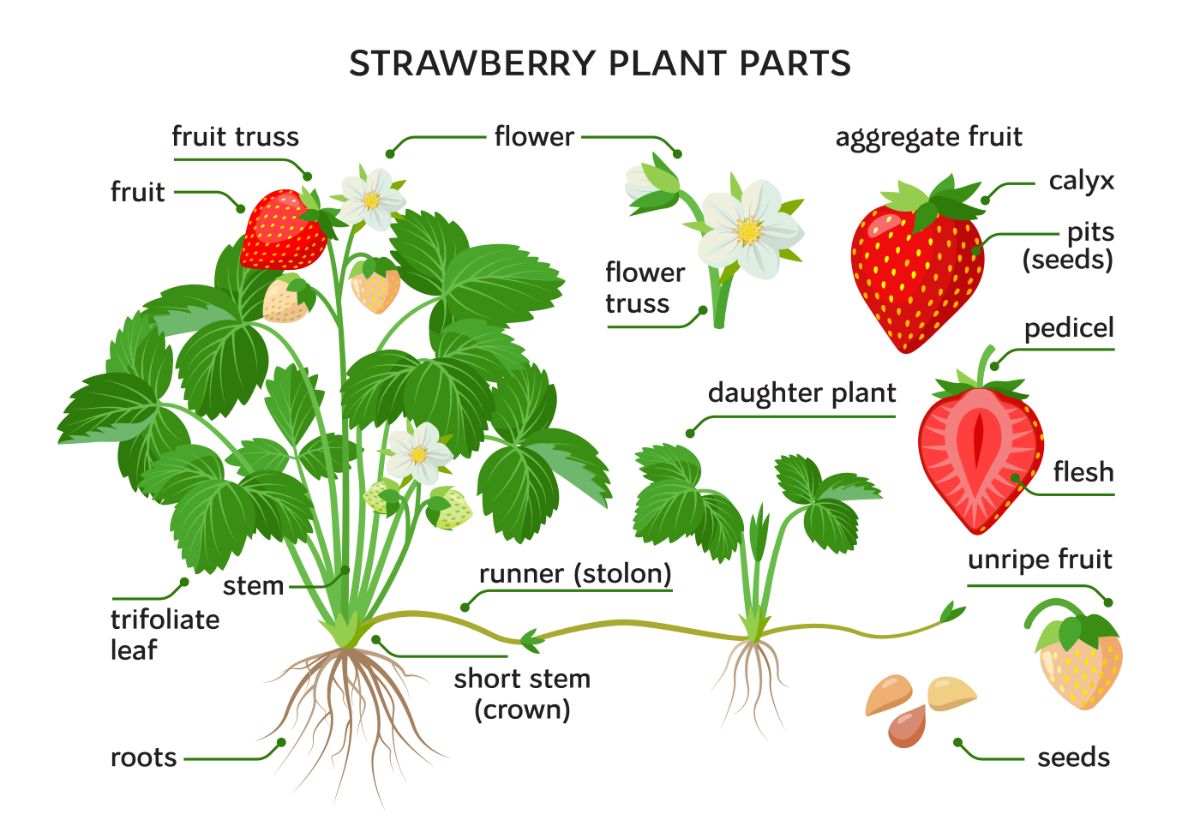
The leaves and the roots of a strawberry plant engage in photosynthesis or absorb water and nutrients from the soil in order to facilitate growth and reproduction. As the top three inches of soil contain about 70% of a strawberry plant’s roots, they are particularly susceptible to drought conditions. If you plan on growing strawberry plants, gain success by learning from the Growing Strawberries page.
The productive engine of a strawberry plant is contained within the crown. It is from this region that strawberry plants produce both runners (stolons) and flowering fruit stalks that eventually yield strawberries. Containing the growth energy of a plant by clipping runners and early flower buds can cause crown multiplication, which will often result in more, higher-quality fruit per plant in subsequent years.
The daughter plants are maintained by the runners until their root bud comes into contact with soil and establishes an independent root system. At that point, the runner will dry, shrivel, and eventually separate completely leaving a new and independent strawberry plant clone.
A Brief History of the Strawberry Plant
For a brief history of the strawberry plant, it is easiest to begin with Fragaria vesca. This species of strawberry plant is native throughout the Northern Hemisphere and goes by many different names. The varying names for Fragaria vesca include: the woodland strawberry, wood strawberry, wild strawberry, European strawberry, fraises des bois, and alpine strawberry (more specifically, the alpine strawberry plant is generally understood to be of the cultivated, everbearing type).
Genetically, an ancestor to the Fragaria vesca species (which is diploid) likely formed a hybrid strawberry plant with an ancestor to the Fragaria iinumae (which is also diploid) to eventually produce the octoploid strawberry plants. The exact hybridization and speciation process that resulted in the formation of an octoploid strawberry plant is not currently known. However, both Fragaria virginiana and Fragaria chiloensis (both octoploid) appear to be genetically identical, and, as a result, all the cultivated varieties of garden strawberries also carry the same genetic complement.
Fragaria vesca strawberries have long been consumed by humans. Archaeological evidence suggests human consumption as far back as the Stone Age. The first cultivated strawberries were grown in ancient Persia. The fruit from these Persian-cultivated strawberry plants was referred to as Toot Farangi. The seeds of this strawberry plant traveled both east and west along the Silk Road and were being widely cultivated from Europe to the Far East.
The first recorded documented botanical illustration of a strawberry plant is believed to be from 1454. A depiction in Herbaries was included as a figure.
Additionally, the American Indians were already consuming native strawberries and using them for culinary purposes prior to the arrival of European colonists. It is believed that Strawberry Shortcake was developed by the colonists by modifying an Indian recipe that created “strawberry bread” by mixing and then baking crushed strawberries with cornmeal.
By the 18th century, Fragaria vesca began to be replaced by Fragaria x ananassa, the Garden Strawberry. This transition occurred because of the desirable traits exhibited by the newly bred strawberry plant: larger fruit and greater variation (easier to breed). The first strawberry hybrid, “Hudson,” was developed later (1780) in the United States.
This new strawberry plant (the Garden Strawberry) was bred in 1740 in Brittany, France, from a North American strawberry plant and a South American strawberry plant. The colonists had been shipping North American strawberry plants back to Europe as early as 1600, and the conquistadors had identified another strawberry plant variety they called “futilla.” The Fragaria virginiana plant was noted for its pleasing flavor and came from the eastern region of what would become the United States of America. The Fragaria chiloensis was noted for its large size and was brought by Amédée- François Frézier from the regions of Argentina and Chile. The breeding was a success as the Garden Strawberry plant has now become the strawberry plant of choice for most commercial and home strawberry growers.
In the early 19th century, strawberry plant cultivation increased dramatically in the United States as ice cream with strawberries became a popular dessert. New York became a strawberry hub in those days. Railroads and refrigerated rail cars allowed the production of strawberries to spread, most notably to Tennessee, Arkansas, Florida, and Louisiana.
Currently, the vast majority of North American strawberries are grown in California (about 75%).
With strawberry plant selection and breeding practices, cultivars have been created that have drastically increased the size of the strawberries. The early strawberry plants had fruit that was very small. Now, many strawberry plants will produce berries that require multiple bites!
Also, with the onset of genomics and gene mapping, the alpine strawberry plant has now become the focus of strawberry plant research. Since it is easy to propagate, has a reproductive cycle of 14-15 weeks in a controlled environment, and has a very small genome size, this strawberry plant has become adopted as a genetic model for the Garden Strawberry specifically and the Rosaceae family generally. It is used as an indicator plant for disease research.
Strawberry Plant Etymology
There is some disagreement as to how the strawberry plant got its name. It is generally accepted that the English word “strawberry” comes from the Old English “streawberige” or the Anglo-Saxon “streoberie” (sometimes also spelled “stroeberrie”). Regardless, it was not spelled in the modern fashion until about 1538. It is likely that the straw that was traditionally used as mulch and to keep the weeds out and berries clean gave rise to the name. However, some argue that the straw-like appearance of the strawberry plant runners led to its current English name.
The genus name under which the strawberry falls, Fragaria, derives from the Latin word for strawberry, “fraga.” And, “fraga” itself is a derivative of “fragum,” which means “fragrant” and accurately characterizes the olfactory sensation that characterizes freshly plucked strawberry fruits!
Strawberry Plant Diseases
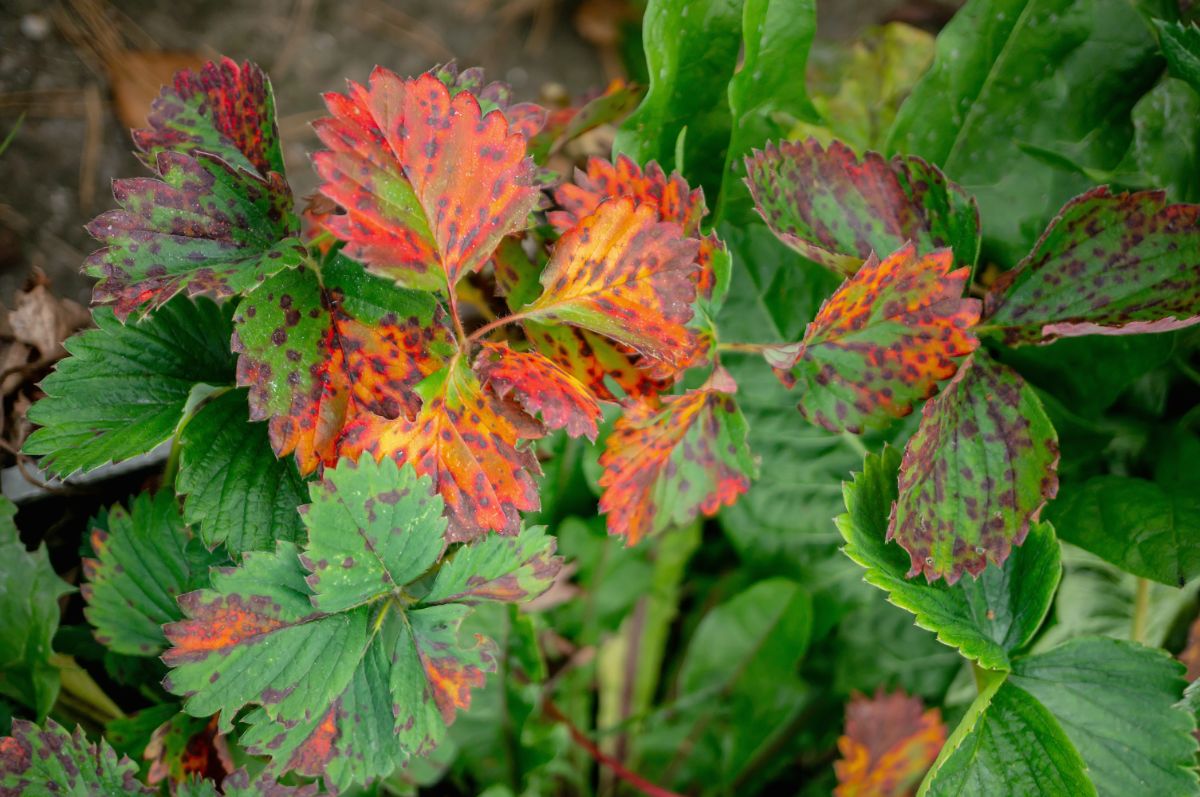
There are quite a few diseases that affect strawberry plants. The strawberry plant’s leaves, roots, and fruit are all susceptible to a variety of diseases, depending on the resistance of the strawberry plant cultivar being considered. This is a summary of the most common strawberry plant diseases:
Red Stele Root Rot
A strawberry plant’s roots are damaged by red stele root rot (also known as Lanarkshire disease). The disease is caused by a fungus living in the soil, and its presence is confirmed in a strawberry plant that has a red core to its roots. The fungus is particularly prevalent in the northern two-thirds of the United States. Heavy clay soils with poor drainage that remain saturated with water during cool weather are most at risk. The fungus that causes red stele root rot is Phytophthora fragariae, and, once established, can remain alive for at least thirteen years (maybe longer), regardless of crop rotation.
Strawberry Plant Leaf Spot
Leaf spot is caused by the fungus Mycosphaerella fragariae and manifests as dark purple to reddish-purple spots on multiple parts of the strawberry plant. The round spots are usually between 1/8 and 1/4 inches in diameter and most easily seen on the leaves of an infected strawberry plant. However, the petioles, stolons, fruit stalks (pedicels), and strawberry caps (calyxes), and ripe strawberries can also be infected. The center of the spots eventually become almost white with tan or gray intermediate steps. The parts of the strawberry plant affected by this disease are the young, succulent ones.
Strawberry Plant Leaf Blight
The fungus Dendrophoma obscurans (also known as Phomopsis obscurans) causes leaf blight, and it typically does its damage after harvest. One to six enlarging, elliptical or angular blemishes will develop on the leaflets and grow up to one inch in width. The spots begin with a reddish-purple color. As they enlarge, they develop a dark brown center that is surrounded by a lighter brown area with a purplish border. This fungus almost exclusively attacks weaker, slow-growing plants and usually ignores youthful runner plants. Dendrophoma obscurans can also cause a spreading, pink, soft rot at the stem end of a strawberry.
Strawberry Plant Leaf Scorch
Leaf scorch is caused by the fungus Diplocarpon earliana, which attacks the strawberry plant’s leaves, calyxes, petioles, runners, and pedicels. In the early stages, it looks like a leaf spot. Later, the lesions develop black spots as the fungal fruiting bodies are produced, but, unlike leaf spot, the centers of the lesions will remain dark purple. Strawberry plant leaves with a severe infection will shrivel and appear scorched. Rarely the fungus will infect green strawberries causing reddish brown spots or flecks to be visible on the unripe fruit.
Strawberry Gray Mold
If a strawberry plant is infected by gray mold, fruit production is likely to be particularly devastated (expect 80-90% loss of both flowers and strawberries). It is caused by the fungus Botrytis cinerea, and wreaks havoc during rainy and cloudy periods just before or during harvest. Strawberries touching dirt, another infected or rotting strawberry, or dead leaves in dense foliage are most commonly affected. The fungus causes infections that manifest as soft, rapidly-growing spots that are light brown in color. The fruit will dry out, darken, and become covered with a dust-like, powdery layer of fungus spores, which gives the gray appearance.
Strawberry Plant Leaf Variegation
Leaf variegation is a mysterious disease, and its cause is currently unknown. It also goes by many other names, including: June yellows, spring yellows, chlorosis, Blakemore yellows, and non-infectious variegation. The disease usually (but not exclusively) occurs in strawberry plants that have Howard 17 (Premier), Blakemore, or Auchincruive Climax cultivars in their plant ancestries. Affecting only flowers and leaves, the disease manifests on new leaflets in the spring as yellow or white streaks or spots and a puckering of the leaflet. While onset is unpredictable, the strawberry plant will progressively manifest worsening symptoms until it dies two to three years later as a dwarfed and unproductive shell of its former self.
Verticillium Wilt of the Strawberry Plant
Verticillium wilt is caused by a very common soil fungus called Verticillium albo-atrum. For new strawberry plantings, symptoms usually manifest as new runners are being produced. Older plantings are usually affected just before harvest. Affected strawberry plants will show different symptoms depending on the cultivar, and affected plants must be tested for definitive diagnosis. The symptoms are not easily distinguished from other strawberry plant root diseases or winter injury. Once established, the fungus will likely survive for 25 years or more.
Leather Rot (Crown Rot) of the Strawberry
Leather rot (also known as crown rot) is caused by the fungus Phytophthora cactorum and affects strawberries in poorly drained soils where there is or has been standing water. Most commonly, the fungus causes brown areas or brown outlines to form on green strawberries. The infected strawberries will have an unpleasant odor and bitter taste. Mature strawberries that are infected may look completely normal and taste terrible. Excessive rainfall in May, June, and July often create the optimal conditions for this fungal infection.
Learn more about strawberry plant diseases and problems caused by bacteria, fungi, molds and viruses.
Strawberry Plant Pests
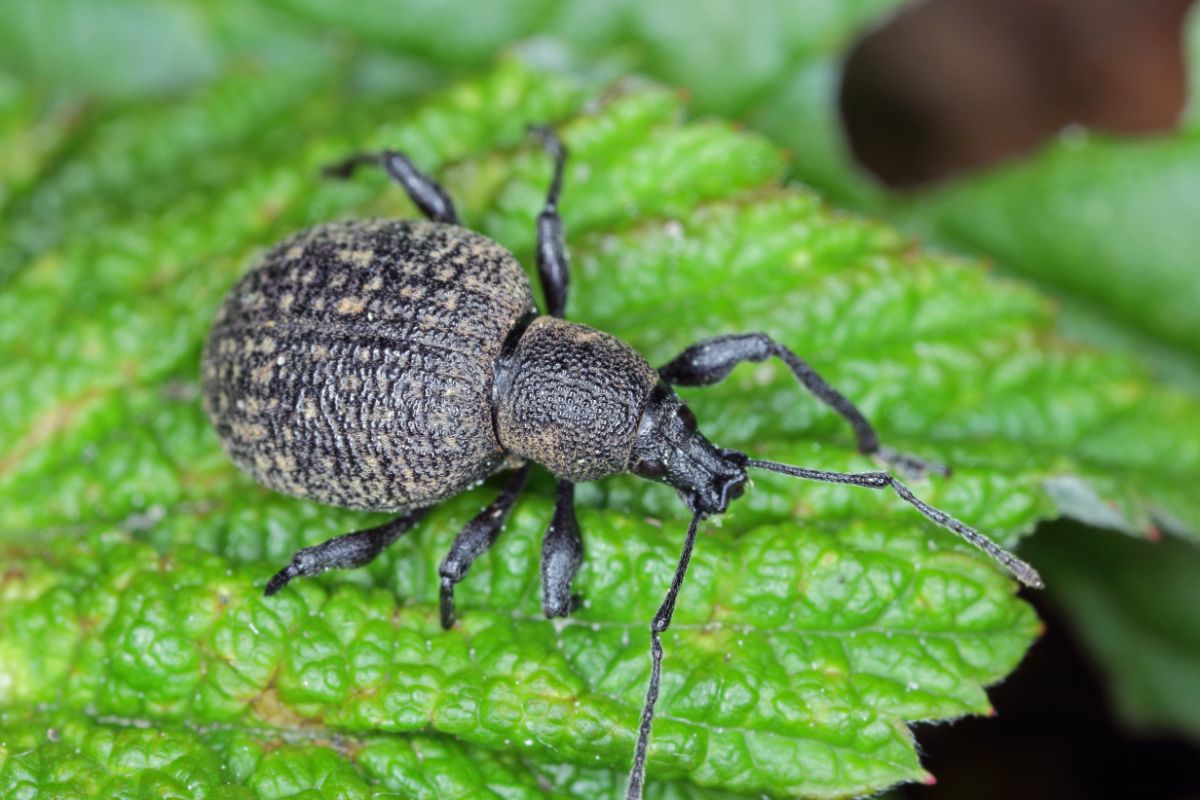
In addition to the strawberry plant diseases mentioned above, there are also numerous strawberry plant pests that can damage or kill your strawberry plants. Here is a summary of the common strawberry plant pests:
Strawberry Crown Borer (Tyloderma fragariae)
These strawberry plant pests are about 1/5 of an inch long and have three spots on their wing covers. They are flightless weevils that feed on strawberry plant crowns to open holes, into which they then lay their eggs through the middle of June. The hatched larva will bore into the crowns causing damage to the growing strawberry plant. The grubs will form a pupa and subsequently become a weevil to feed on the plant’s leaves.
Strawberry Root Weevil (Otiorhynchus ovatus)
Root weevils are about 1/3 of an inch long and have wing covers distinguished by many rows of small pits. Adult weevils will lay eggs into the soil. Hatched larvae will burrow through the soil and feed on the roots and crowns of a nearby strawberry plant causing damage or death. The adult weevils will feed on the leaves.
White Grubs (Phyllophaga)
White grubs range from 1/2 to 1 inch and eventually become the large May or June beetles (also called “June bugs”) common to many parts of the United States. The grubs burrow into the soil and overwinter twice before taking beetle form. Consequently, the grubs can do damage to the roots of strawberry plants for multiple years as they feed.
Strawberry Rootworm (Paria fragariae)
Adult beetles are shiny, oval-shaped, dark brown to black, about 1/3 of an inch long, and display four blotches on their wing covers. Adults feed on the leaves through early fall and can cover strawberry plant foliage with holes. The larvae burrow into the soil and feed on the roots.
Strawberry Root Aphid (Aphis forbesi)
Also known as the strawberry root louse, this small strawberry plant pest is about 1 mm in length, has an oval and dark bluish-green body, and has a yellowish head. They feed on the roots and crowns of strawberry plants and can be quite numerous if infestation occurs.
Strawberry Leafrollers (Ancylis comptana fragariae)
The adult moths emerge in April or May to lay their eggs on the strawberry plant, usually on the underside of the leaflets. The translucent eggs then hatch and the larvae feed on the epidermis of the leaves, secreting silk threads as they go to tie the leaflets together. Other species of leafrollers also feed on the strawberry plant, but none of them usually cause significant damage to the overall strawberry planting.
Strawberry Mites (Tetranychus urticae and Steneotarsonemus pallidus)
The two-spotted spider mite and the cyclamen mite can wreak havoc on strawberry plants. The spider mites damage leaf surfaces in order to feed on sap, while the cyclamen mites feed on new, unfolding leaves and blossoms. Both will cause leaf death and drop, and the cyclamen mite causes distorted fruits.
Strawberry Clipper (Anthonomus signatus)
Also known as the strawberry weevil, these pests are about 1/10 of an inch long, dark reddish-brown, and have a long and slender, curved snout. The adults feed on pollen inside the almost-mature flower, subsequently laying an egg inside the flower. They then girdle the bud to prevent opening and clip the stem so that it hangs or falls to the ground.
Tarnished Plant Bug (Lygus lineolaris)
Also known as the Lygus bug, these strawberry plant pests are about 1/4 of an inch long and are distinguished by a yellow “V” marking on their back just behind the head. In the spring they feed on strawberry plant flowers which results in disfigured and knobby strawberries.
Slugs (Agriolimax and Arion species)
Slugs will eat deep holes into strawberries and leave slime trails over the strawberry plant. The damaged strawberries will begin to decay quickly. Slugs can do great damage to a strawberry harvest.
Birds
Birds will find a way to rob at least some of your strawberries from your strawberry plants before you are able to pick them. To minimize the loss, plant more strawberry plants than you need, and cover the area with bird netting to keep the thieves out as much as possible.
Learn more about keeping birds, bugs, and other pests away from your strawberries.
The Nutritional Value of Strawberries
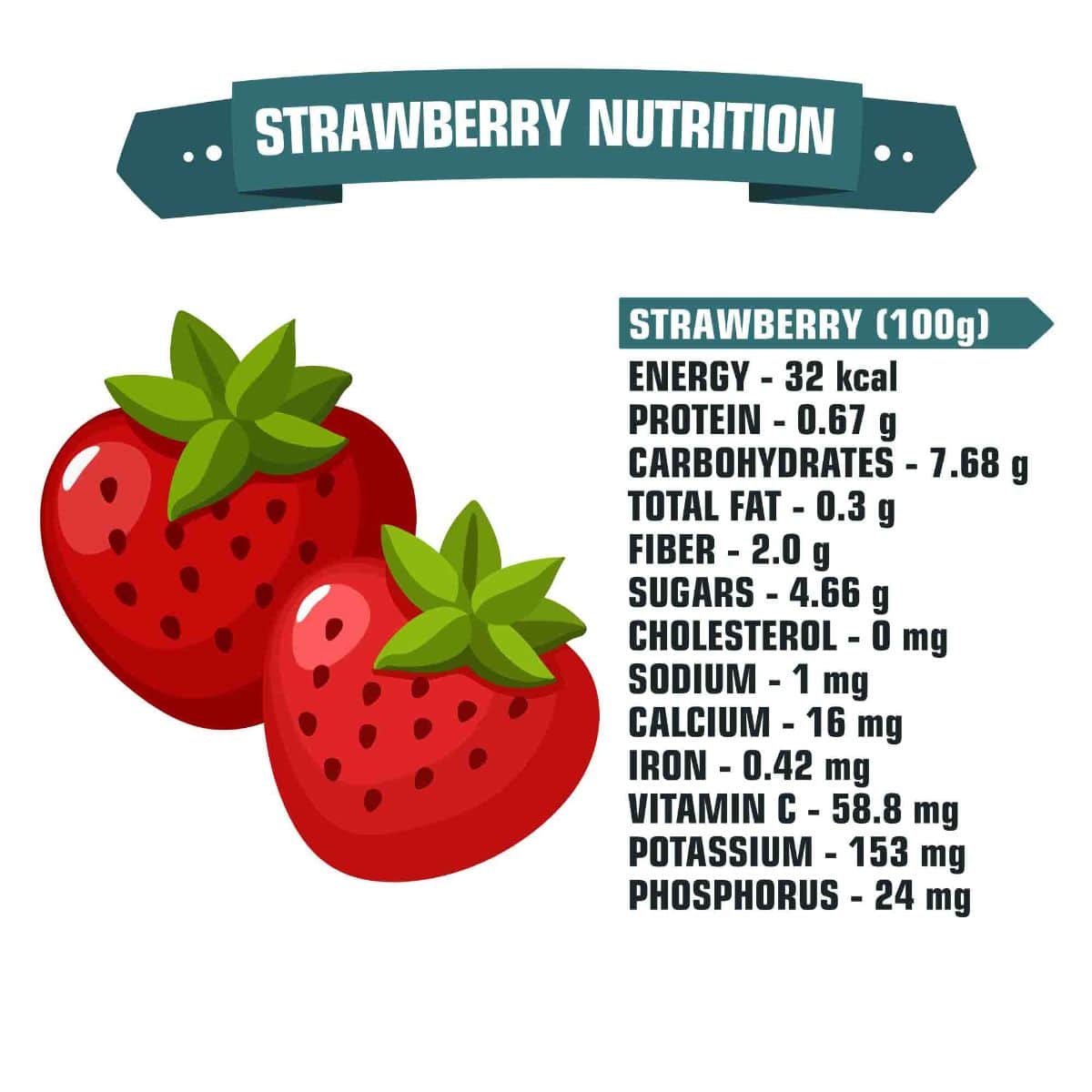
The fruit of the strawberry plant is packed with beneficial nutrients, particularly Vitamin C and flavonoids. One cup of strawberries weighs approximately 144 grams and contains between 45 and 50 calories. Strawberries are over 90% water, 7% carbohydrates, about 2% fiber, and less than 1% each of protein, fat, and ash.
Strawberries are also a dietary source of minerals and vitamins. The following minerals are in strawberries, in descending amounts: potassium, phosphorus, calcium, magnesium, sodium, iron, manganese, zinc, copper, and selenium. Strawberries are also a good source of the following vitamins: Vitamin C, thiamine, riboflavin, niacin, pantothenic acid, Vitamin B6, Folate, Vitamin B12, Vitamin A, and Vitamin E. Additionally, strawberries contain 18 different amino acids.
Basically, unless you have a strawberry allergy, you can’t go wrong eating fresh, clean strawberries. They are quite good for you!
Strawberry Allergies
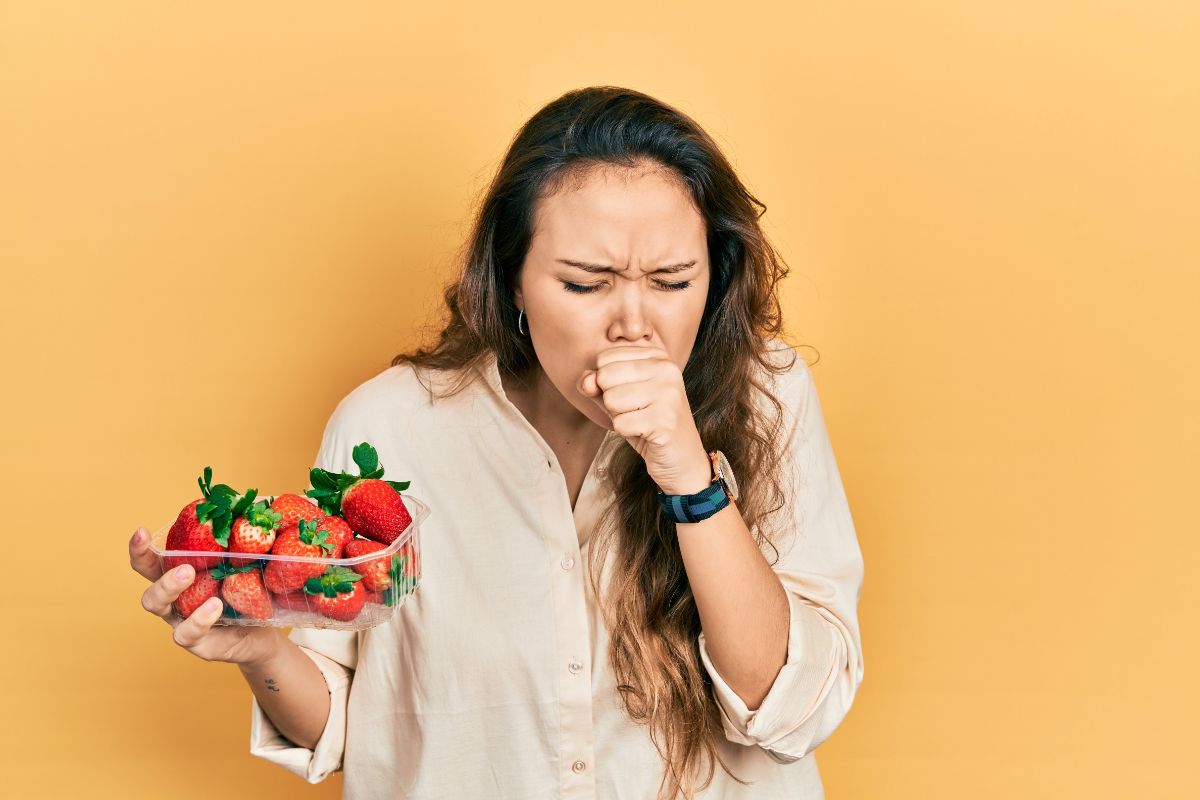
Some individuals have allergic reactions to strawberries if they consume them. The most common of these is called oral allergy syndrome. However, allergic symptoms similar to those of hay fever are also prevalent. Skin problems such as dermatitis or hives can also occur, and, in serious cases, breathing problems can develop.
The specific allergen responsible for provoking the reaction is thought to be tied to a protein named Fragaria allergen 1, or Fra a1 for short. This protein is thought to be involved in the ripening process the berries go through. Consequently, strawberry plant cultivars that produce white, pale, or yellow “golden” fruit due to their lacking Fra a1, may be able to be consumed by individuals normally allergic to strawberries. The Sofar cultivar is thought to be virtually allergen-free. For more details, see the Strawberry Allergy page.
Strawberry Plant Lore and Trivia
The fruit of the strawberry plant has been around for a very, very long time. Being as delectable as it is, it is no surprise that it has had an impact on various cultures and has been inserted into literature through the ages. These strawberry plant facts may satiate those curious about strawberry lore.
In ancient Roman times, the strawberry was a symbol for the goddess of beauty, love, and fertility, presumably due to its red color and being shaped like a heart. In fact, legend still holds that breaking a “double” strawberry in half and then consuming it with a member of the opposite sex will cause the pair to fall in love.
Medieval stone masons used depictions of strawberries etched or carved on alters, in churches, and in cathedrals to symbolize righteous perfection.
It is also reported that the second wife of King Henry VIII had a birthmark on her neck shaped like a strawberry. Supposedly, this birthmark cemented her status as a witch. Regardless, she died at the hands of the executioner in 1536.
Shakespeare also decided to use the strawberry as a symbolic decoration on Desdemonda’s handkerchief in Othello.
The delicate fruit of the strawberry plant has always represented purity, passion, and even healing. Herbal teas are made from the leaves, stems, and flowers. It is believed that the strawberries and other parts of the strawberry plant can alleviate or aid in the treatment of various diseases or disorders including: diarrhea, gout, kidney stones, bad breath, throat infections, fevers, inflammatory conditions, fainting, melancholy or depression, and diseases of the blood, spleen, and liver.
In the late 18th and early 19th centuries, Madame Tallien, a social figure during the French Revolution, is reported to have found a unique use for strawberries: bathing. The socialite and fashionista is reported to have bathed in the strawberry juice of over 20 pounds of strawberries for its healing properties.
Indeed, strawberries still have ceremonial roles today. In parts of Bavaria, the people still perform the yearly rite of tying little baskets of wild strawberries to the horns of their cattle. They do this as an offering to elves. They believe that the elves crave the sweet berries and will help the cattle produce abundant milk and healthy calves in return.
The Strawberry Plant: Conclusion
Many volumes of information and details could be written about the strawberry plant. Hopefully, you’ve found what you were looking for on this page. If not, feel free to contact us or leave a comment regarding the information you are seeking.
And, be sure to check back often for updated articles on the various aspects of the strawberry plant! New articles will be posted below with links.
More:
Strawberry Pollination
Strawberry pollination is not very difficult. However, pollinating strawberries has some surprising benefits. Learn why and how to pollinate strawberries. The benefits are multitudinous!
Strawberry Plants with Yellow Flowers
Do strawberry plants have yellow flowers? If you’ve found strawberries with yellow flowers…you haven’t. Strawberry plants with yellow flowers are the false strawberry weed. Details are here.
Wilting Strawberry Plants
Do you have wilting strawberry plants? Why do strawberry plants wilt? See this post to learn about what causes strawberries to wilt and the why behind the top five causes of wilted strawberries look no further.
Nitrogen Deficiency in Strawberry Plants
Do you have strawberry plants with yellow leaves? Nitrogen deficiency in strawberry plants often causes strawberries with yellow leaves. Learn how to remedy nitrogen deficiency in strawberries.
Strawberry Seedlings
Learn about newborn strawberry plants here: planting strawberry seedlings, handling strawberry seedlings, hardening strawberry seedlings, and everything about the strawberry seedling!
How Many Strawberries Do Strawberry Plants Produce?
Find out all you need to know about the quantities of strawberries you can expect to harvest: by plant, by row foot, or by acre. Use this info to plan ahead for your needs!
Strawberry Allergy
Do you have a strawberry allergy? Being allergic to strawberries or having strawberry allergies is hard. Being allergic to strawberry proteins diminishes enjoyment! Strawberry allergy details are here.
Genetics of Strawberry Plants
The genetics of strawberry plants and strawberry genetics are discussed here. Learn about the strawberry plant genetics for different strawberry plant species.
Life Cycle of Strawberry Plants
The life cycle of strawberry plants & the growth cycle of strawberry plants are unique. Learn about the life arc of the humble strawberry plant here.
Compounds in Strawberry Plants
Use this database of compounds in strawberry plants to identify and target useful strawberry compounds. This may be of particular use to herbalists or other ethnobotanists.
Strawberry Flowers
Each strawberry flower turns into a strawberry. Here we discuss where strawberry flowers come from, strawberry flower care, & other info on strawberry flowers.
What Are Strawberry Plant Runners? (Stolons)
What are strawberry runners? The details of strawberry plant runners are here. Find out the benefits, drawbacks, & usefulness of runners on a strawberry plant.
Avoiding Birds, Bugs, and Other Pests
In this article we will give you some simple suggestions for letting our animal friends find other sources of sustenance and keeping your strawberries for yourself.
Strawberry Plant Diseases
Strawberry diseases can affect fruit, flowers, leaves, roots, and crowns of strawberry plants, and sometimes cause the collapse of the whole plant. Learn about bacteria, fungi, molds and viruses.



Issac lor says
You could plant strawberries in spring, and summer depending on the fahrenheit is its 60 to 80 fahrenheit its good for planting if cold it have a high chance of dying in cold celcius.
Linda Blanchard says
Where can one get Sofar strawberries? I’ve had strawberry allergies (of the dermititis type) since I was a kid.
Issac lor says
Maybe the the allergies is Fra a 1 its a allergies common from strawberries.
Matt says
This guide is great! I’ve started to work on strawberries in a laboratory environment, & I was in need of a handy guide for morphology, reproduction, etc. Thanks for providing so much helpful content!
matt says
Hi –
I purchased some strawberry plants from local place this march. had them in my garage in this planter and have had them outside for past 6 weeks or so.
they are juneberry variety and getting full sun.
i water once about every 2 days.
i don’t see any strawberries yet? I am a beginner so think i am doing something wrong….
we are located in a suburb of philadelphia, pa.
any help appreciated.
Steve Thompson says
Mr. Strawberry we have a raised bed of Puget Crimson strawberries (2-3 years old) and I am finding worms that are brownish and about 3/4″ long attaching to the outside of berries that are touching the dirt. Other than continually lifting/propping the ripening berries so they don’t touch the soil do you have any recommendations to eliminate or control the worms?
Amanda says
My second year strawberry plants are looking healthy and flowering with a few berries already, but the container i have them in looks really crowded and lots of leaves. How do I get good air flow without hurting them. Should I cut back the leaves?
Rachael S. says
Something ate my strawberry flowers and buds. I have June bearing and overbearing. Will they produce flowers and buds again? It all just looks like leaves now.
robert walker says
so it’s sept. 16th, and my plants are in full bloom, in Washington state! they are producing berries, I’ve had these same plants for years now and they have never bloomed this late in the year! so what’s up?
Rosie says
Hello, I’m a quality assurance inspector (QA) for a produce company and I just wanted to know what do I look for when I’m inspecting strawberry plants. Are the roots suppose to be wet or dry with some soil in order to know if the plants are good quality?
Arjun says
The leaves of strawberry plant are destroyed due to fungus infection
Please tell me the spray which I wish I can control mys traw Berry plant from eating leaves
Bruce Thompson says
What can be done to prevent thrips from damaging our strawbs?
Carolyn says
Very healthy looking plants and flowers, tiny fingernail sized berries. Nothing like this before. Second year plants. Used Miracle Grow. Soil test good but I’m doing another. Any other ideas?
Mike Beavis says
Dear Mr Strawberry
The new leaves on my strawberry plants are coming out yellow, and only turning green after several weeks. This does not seem to fit the Nitrogen deficient diagnosis on your site, as the medium and older leaves are remaining green. I could not spot any other disease/pest that produced similar symptoms. We are in North Wales, near the sea. Could salt be a factor. I would welcome some transatlantic advice.
Mike Beavis
Jerry P says
Hi, I need help figuring out what is afflicting our strawberries – a 2 year old dense row flanked by 1 year old rows on either side, with some hay mulch underneath, in upstate New York, in a valley where we have frequent fog in the morning. Our soil is gravelly and well-drained; and I’ve applied some 10:10:10 fertilizer in watering twice this season. That’s our setting.
The issue of the past several weeks is an increasing percentage of the fruits turning soft and extremely mushy, seemingly from the inside outward, as they mature and turn red, so that by the time they’re ready to pick, the fruit is a drippy mess of gross mush inside a skin that doesn’t look too bad; If I leave it, it the skin also turns a soft dark purple. Other details: Did have slug problems earlier in the season, and used Ortho’s Bug-Geta slug bait for that, so that we now have very few fruit that have obvious slug damage. Also presently have lots of gnats (fruit flies?) that rise in clouds off the plants whenever I go through them to examine and pick the fruit. Didn’t know if they were related to the mushy rot, though I’ve seen no evidence of fruit fly maggots in the fruit I’ve picked. I’ve tried to discard all mushy and the few moldy fruit, but fruit flies might be multiplying in ones I’ve missed? Also have noted that the fruit I pick tends to have a bit of brown color in its core in its progress toward the mushiness. I read somewhere that this might be due to Calcium deficiency; but I suspect some sort of disease, perhaps bacterial? The disease, if it is such, seems worse in the dense areas of the planting, and not as prevalent in the younger, better aerated plants. Any thoughts? – Jerry P
Mr. Strawberry says
Jerry P,
It could be any of the things you mentioned. I’d have your soil tested to rule out deficiencies and then thin the planting to allow better air flow. More than likely, you have a fungal infection in your planting that is causing the fruit rot. Good luck!
vicki says
I have a horrible case of leaf scorch in my strawberries. What type of fungicides are best to use and what would be the best time to treat the plants.
Claire says
I am really new to gardening. I’ve started with some Strawberry plants. Today I have noticed that there are some holes in the leaves.
When I turned the leaf over I could see some small reddish 1mm mite looking creatures. I have pulled off every mite I could find 6/8 in total.
Please could you tell me what you think these are. I’m sure that they are not spider mites.
Kind Regards
Mrs Claire Parfitt
Mr. Strawberry says
Claire,
There is a good chance that those small reddish bugs are aphids that are feeding on the plants. You might want to try a liberal application of diatomaceous earth and see if that helps keep them at bay. Good luck!
Leslie Bailey says
Hi, I’m on my 3rd year with my strawberries, and this year they started out looking great! Unfortunately now they seem to have leaf scorch. I’ve narrowed out leaf spot because it’s not just the leaves. The stems, and “caps” of the berries as well as the leaves have reddish spots on them, and I swear they’re getting worse every day! Is there a way to stop this, or cure it? Will it kill off my strawberries, and are the berries even safe to eat? Please help! (Also, I’ve been trying to do research on this, and I’ve noticed a mistake I’ve made. I definitely need to thin them out a bit, as I have one middle row that is very full, like 4 feet wide.)
Mr. Strawberry says
Leslie Bailey,
You can usually kill off the leaf scorch with fungicides, but I definitely wouldn’t recommend eating the berries afterward. And, yes, thin them! The lack of adequate air flow between plants can make them more prone to fungal infections! Good luck!
Kate says
I am growing thick leaved strawberries as a ground cover and was wondering if I am able to propagate the daughter root balls off of the runners by clipping them off and planting them else where? Is there a better way to propagate? What time of year is best?
Mr. Strawberry says
Kate,
No, if you simply snip the runner and try to plant the nodal daughter plant, it will most likely die. You can snip them and transplant them, but only after the daughter plant as some roots established in the soil. Once that happens, snip and move! See this for strawberry propagation. Good luck!
Lori walton says
My strawberry plant leaves are curling in. What’s wrong?? Please help
Mr. Strawberry says
Lori walton,
The most common cause is calcium deficiency, which can often be caused by irregular or uneven watering. Boron deficiency can also cause it. I’d recommend having your soil tested. Good luck!
Elizabeth says
If you have Stawberry plants infected with Leaf Spot are the fruit still edible? If I have multiple plants in a row and only one shows signs of Leaf Spots should I remove that plant or just assume they will have the disease (they were all bought together).
Mr. Strawberry says
Elizabeth,
Yes, you can still eat the fruits. If the leaf spot infects the berries themselves, they will get little black spots on them around the seeds. If that happens, you should cut off the affected areas, but the rest of the fruit can be safely eaten. Leaf Spot is caused by a fungus, which can be tough to get rid of completely. I would remove infected vegetation, but the plant should be okay overall. Good luck!
M Javed Iqbal Adv says
I want to grow strawberries in Pakistan in upper Punjab on commercial basis how can I utilize your experience regarding choice of plants to grow & how to grow & how to treat them etc…
Mr. Strawberry says
M Javed Iqbal Adv,
Unfortunately, I’m not sure I can help you all that much with the specifics of which variety to choose. However, you can learn much about the growing of strawberry plants here. Good luck!
Distressed Gardener says
Hello there. Do you have any information about how to overcome angular leaf spot caused by the bacteria Xanthomonas fragariae? I think my indoor strawberry plants may be afflicted and really hate the idea of tossing everything out and starting over because they have just started producing bountiful 30 gram berries 🙁
Amanda says
I think my strawberry plants are being attacked by lygus bugs, how do I control them organically please?
Mr. Strawberry says
Amanda,
You can try cayenne power and diatomaceous earth. Good luck!
clara krathwohl says
for two years some of my strawberry plants have developed a peculiar pod, either attached to a runner or the stem of one or more of the leaves. Not sure if fruit production has been affected since they are still younger plants. I break open the pods and a single (that I can see anyway) worm is inside. What is this, what causes this and how can you naturally take care of it. I’ve been trying to look up this worm thing and can’t find a single thing about it. Please help!!!!!
Mr. Strawberry says
clara krathwohl,
My guess would be that it is a moth or butterfly of some sort, and the pod is its chrysalis. You might want to try liberal applications of diatomaceous earth to see if that will keep them at bay. Good luck!
Stephen says
My strawberry plants drop most of the fruit off the plant ,can you tell me what’s wrong with them thanks the plants look in good condition but keep dropping most of the fruit off.
Mr. Strawberry says
Stephen,
You might have a beetle or other insect damaging the stems and causing the fruit to drop. Sometimes, nutrient deficiencies can also cause it. I’d recommend calling your local agricultural extension agent to come have a look. He can probably identify the exact problem for you and tell you how to treat the condition as well. Good luck!
Kris says
Hi,
I have strawberry plants that around 3 to 4 years old. The plants are healthy and spreading well,but their berries are small,never firm and most seem like they are missing their core. There is a hole where the white core should be. I read one of your responses that recommend pinching off the flowers to make the plant put more energy into itself and wanted to see if that is the correct thing for me to do as well ? Thank you for your help !
Mr. Strawberry says
Kris,
Actually, it is likely that you have a bit of a different issue going on. Once plants reach year 4, their productivity typically starts to decline rapidly. It would probably be a good idea to start over with new plants at this point or start a transplanting system. Good luck!
Max says
Hi
Many thanks for the reply. Couldn’t see anything in the library but there is every chance I missed it. I posted on another forum and was told that it looks like leaf miner. Would be great to get a second opinion… Is there any way I can post pics or links to pics?
Cheers
Max
Mr. Strawberry says
Max,
Try this resource. They have pictures of most things that you can compare to. Good luck!