





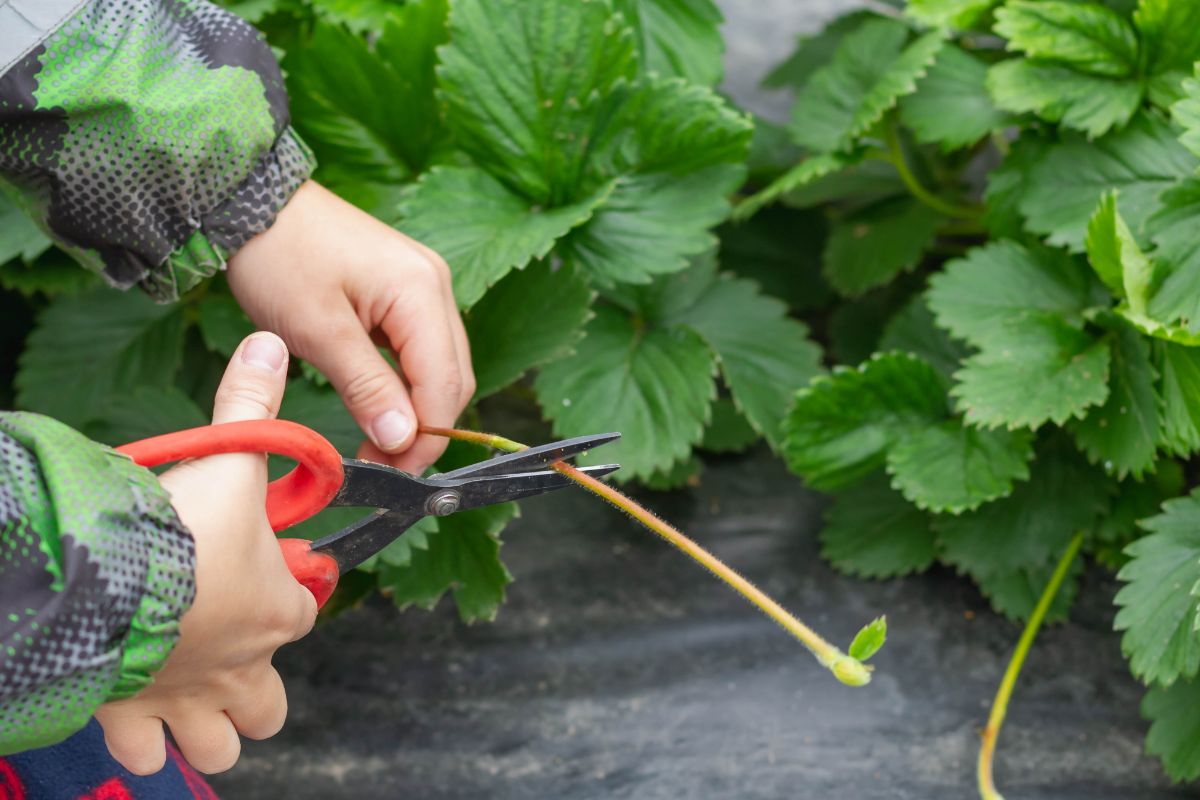
Most of the commonly cultivated varieties of strawberry plants (Fragaria x ananassa) will produce “runners” as a means of propagating themselves. Anyone who grows strawberries is probably familiar with the term and, at some point, probably experienced at least a twinge of curiosity regarding them. You may have even asked yourself, “Exactly what are strawberry runners ?” Be curious no longer, for you are about to find out!
Jump to:
Background Information about Strawberry Runners
Strawberry runners are properly called “stolons.” The word “stolon” comes from the Latin word “stolo” meaning a shoot, branch, or twig springing from the root. Stolons are produced by virtually all June-bearing strawberry plants and most everbearing and day-neutral strawberry varieties. By definition, stolons are horizontal connections between organisms, and they can arise from the organism or its skeleton. Animal stolons are usually formed from exoskeletons, and are outside the scope of a post about strawberry plant runners.
Strawberry plants produce runners. These stolons are horizontal stems that run above the ground and produce new clone plants at nodes spaced at varying intervals. Since strawberry plants possess stolons, they are considered “stoloniferous.” The long, leafless stems between the mother plant, plant-growing nodes, and growing tip of the stolon are called “internodes.”
Adventitious Roots on a Strawberry Runner
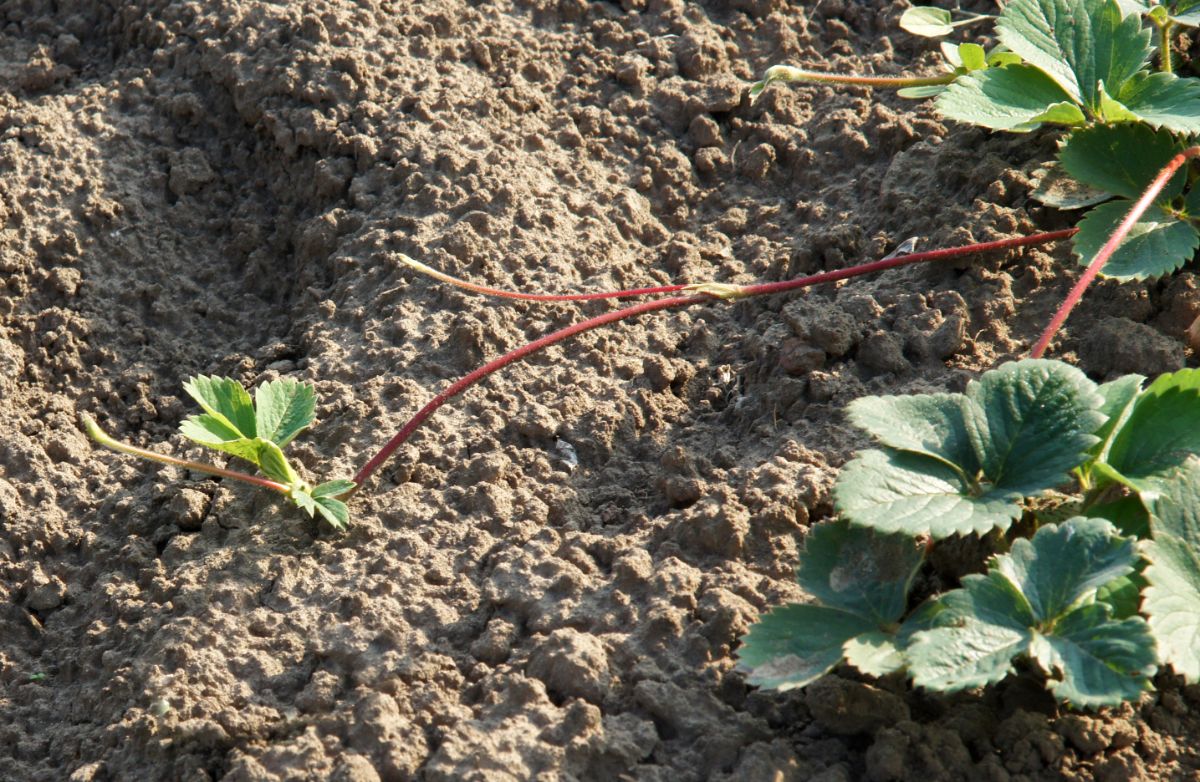
Most plants have a root system that consists of a primary root or primary roots with root branches forming and growing from the primary root. Strawberry plants have this arrangement for the majority of their root system. However, they also have a special advantage: adventitious root formation at the nodes of their stolons.
Adventitious roots manifest away from the primary roots of a plant, originating instead from the stem, branches, leaves, or old and woody roots. As the name implies, this gives certain plants somewhat of an advantage over other plants. In the case of strawberry plants, they are able to propagate themselves laterally in different directions via runners to find more suitable growing locations for their clone offspring. This allows them to find better soil or areas of better sunlight.
As the strawberry plant runners are sent out, the nodes will develop the adventitious roots, sent them downward, and establish the new clone plant once contact with soil is made. Once established, the intermodal runners will dry, shrivel, turn brown, and eventually separate leaving two independent plants: the original and the clone. These special roots make it easy to start growing strawberry plants from a runner.
Benefits of Strawberry Runners
For the gardener or farmer, strawberry runners can offer significant benefits. For perennial strawberry beds, matted rows that will produce bumper crops of strawberries can be established (see the Growing Strawberries page for additional details) using only a few purchased or transplanted mother plants. This saves money as well as time (the farmer has to plant few plants!).
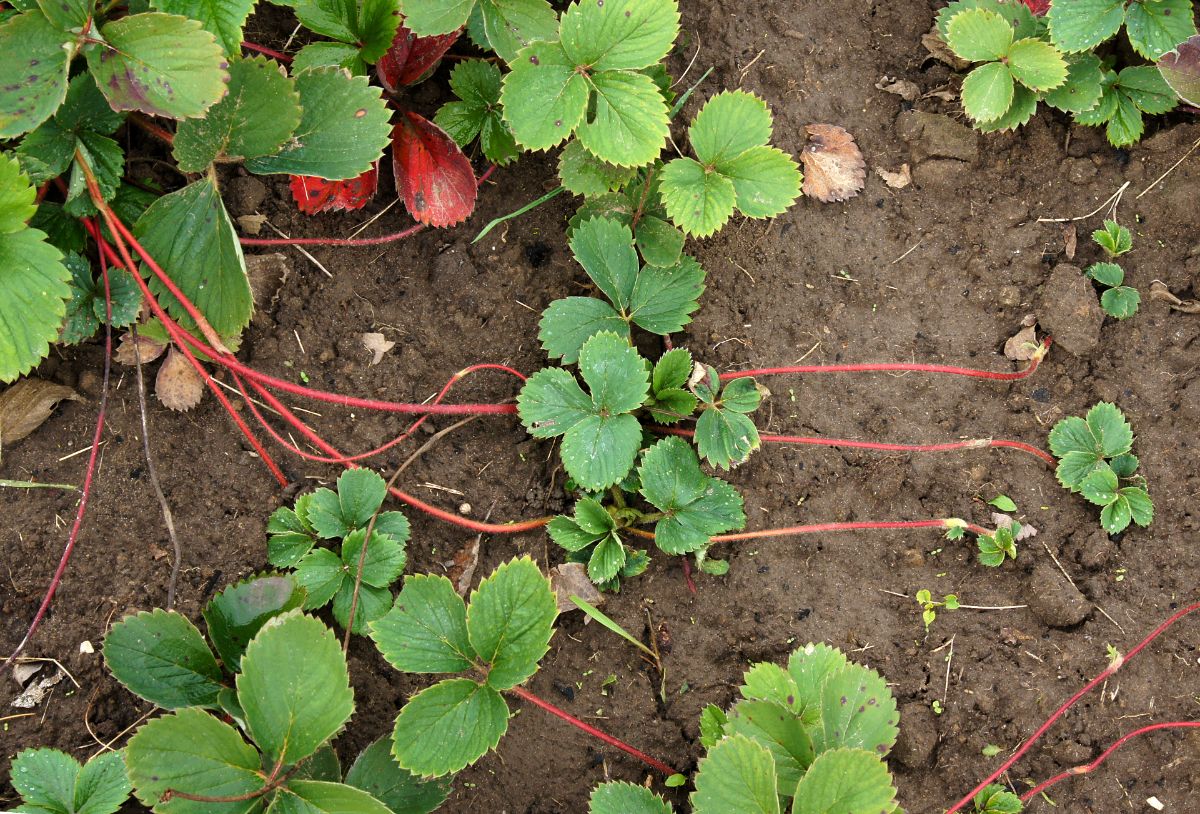
If planted in ideal conditions with regulated and appropriate amounts of water applied, most strawberry plants will produce abundant numbers of runner plants. Under ideal conditions it is not uncommon for a single plant to produce between 30 and 50 runners, depending on the vigor and qualities of the variety.
For nurseries or commercial operations, the constant production of new strawberry plants yields a return on the initial investment as the new clones are sold. A nursery or gardener can also make use of the adventitious roots. Since the strawberry plant runners are fairly flexible, the nodes can be positioned above pots, plug trays, or other growing medium. Once the root touches the soil, it will grow right where placed. Once established, the new clone plant can be separated from the mother plant and carried off in its new container, pot, or plug tray. This makes them easy to transport, sell, or re-plant elsewhere to establish a new strawberry patch.
Drawbacks of Strawberry Runners
All is not rosy in strawberry runner world, however. There are a few drawbacks to the production of strawberry plant stolons. The strawberry plants don’t understand the desires of a gardener. They only want to eat, grow, and reproduce. As such, they don’t stop sending out runners when you would like them to do so. Because of this, strawberry beds have to be thinned and renovated in order to maintain maximal production and vigor.
The prolific runner production of many of the different Strawberry Varieties also makes them somewhat invasive. Without having a dedicated area for growing strawberry plants, many cultivars will take over a garden and can choke out other plants. Runners facilitate this lateral, invasive spread.
Additionally, it takes productive energy for a strawberry plant to send out runners. The propagating energy used up in stolon production does not go into production of strawberries. Since most people grow strawberry plants for the strawberries and not the runners, it may be necessary to prune the runners so that more productive capacity is manifested in more and bigger fruits.
Strawberry Plant Runners: Conclusion
As with most things, there are positives and negatives when it comes to the runners on a strawberry plant. Should they stay and grow, or should you prune them? There is no answer that is correct for every situation. But, hopefully, you understand strawberry runners well enough now to make an informed decision that will be best for your specific cultivar and your garden!
(If all you are getting from your strawberry plants is runners and no strawberries, see this post to understand the top 10 reasons why that may be happening: Strawberry Plants Producing Runners but no Strawberries?)
Hooray for strawberry runners!


Amy says
A few of my mother plants have leaf blight, and a few others have leaf spot. I will be getting rid of them and starting a new strawberry one all together, but what about the attached runners? They do not appear to be diseased, but I still think I should get rid of them as well. Thoughts?
zaw says
what fertilizer can make a strawberry produce more runners?
Big Man LeBron says
High nitrogen
Justin Shelor says
I have beem growing strawberry plants for about 6 years now. I havr my one original bed that strawberry runners took over spreading out and I moved to a few plants to another bed. Most runners did not survive. However, the run tuff plant sent out too many runners. Noe I have like 7 rows of strawberry plants. It is only May and I already have runners sending out with many numerous unripened green strawberries. I will already have to start cutting runners before my berries ripen. This happened after i had snipped yellowish and brown leaves to provide better aeration at the bottom.
Jeana says
Good afternoon,
My strawberry plants grew a new plant/new crown beside it with no intermodal runners aka stems. What is this called and should I/ can I seperate them. I bought them from home depo last year and they dont tell you what kind of strawberries your buying, but it’s one of or the only place to get strawberries in the Virgin Islands. The fruits are kinda small and tart but yummy.
Thank you for any information you can give me,
Island girl
Amber says
I have the same thing happening and I don’t know if it’s a new mother plant or WHAT because I’ve never grown strawberries before! I have several “shoots with leaves” and I don’t know whether or not to snip them because they do in fact have leaves and I’m under the impression that “runners” don’t have leaves. Now I’m learning that strawberry runners are actually stolons. I’m soooo confused! My gut tells me to snip away any leaves that don’t have flowers/blooms so that the berries grow bigger (they’re really small). However, some “stems with leaves” are fuzzy while some are not and I don’t see any white flowers or baby berry blooms coming any of the leaves, fuzzy or not. Sigh.
Henry says
Hi there, Apologies if you’ve already answered this question. I read that you should replace Strawberry plants every 3 years. Will runners do that job? Do they start from year 1 or are they on the same 3 year cycle? Thank you
Mr. Strawberry says
Henry,
Try this method. Good luck!
Libby says
Hi, our strawberry plants are very healthy and are sending out runners, however many of them are turning brown and dying at the tip before leaves really form. What would the cause of this be?
Mr. Strawberry says
Libby,
If you have rabbits or other furry critters, they could be damaging them. Also, some nutrient deficiencies in the soil can lead to this. Have you had your soil tested? If you haven’t, you might want to consider starting there. Good luck!
regi says
Sir Strawberry,
I’m from the Philippines, i plated my strawberries 3 months ago, i wanted them to produce runners, however my plants keep on giving me fruits but no runners which i wanted so i can plant more. Is there a way to induce my strawberries to produce runners?
Thank you so much in advance.
Mr. Strawberry says
regi,
I’d just give them a few more weeks. The plants will likely start producing runners toward the end of the harvest. Good luck!
Louise says
Hi. Do the runners jave to be in soil to produce new flowets/fruit off the runners. I was thinking of trying to vertically trail the runners. I have a rabbit so everything in my garden has to be high up.
Mr. Strawberry says
Louise,
Runner plants should be rooted. Vertically trailing the runners won’t be successful in the long run if the nodes aren’t connected to soil/a nutrient source. Good luck!
chris guy says
hi my stawberry plant is about 2 years old,has runners and has inumerous flower both on the main plant and on the runners am i in for a bumper crop this year.thanks
Mr. Strawberry says
chris guy,
Great to hear that! Good luck!
DEBBIE says
Had a friend give me strawberry runners and I don’t have my bed ready. How do I store the runners until I’m ready. Thanks!
Mr. Strawberry says
DEBBIE,
If they are in soil, just keep them watered. If they are bare-root, see this. Good luck!
Aizuddin Azhar says
Hi, do you need to wait the runners to start growing adventitious roots before hooking them up in place? Mine’s not growing any. And do additional plantlets grow from a single runner that produced more than one node?
Mr. Strawberry says
Aizuddin Azhar,
No, as soon as the leaflets sprout from the runner, you can affix the bottom of that spot to the soil, and it will root there eventually. Yes, if a runner has more than one node, an individual plant will grow at each node. Good luck!
Grace says
Hi, I have plants growing on plastic mulch, through a hole about 5cm in diameter. The plant has filled the entire opening. It is still fruiting ( new plants about 8 months old ) We would like to obtain stolons from these plants. Do the openings need to be widened to allow the plants to grow more leaves? There are lots of bugs under the plants that fly off when disturbed. DO you know what they are?
Mr. Strawberry says
Grace,
As long as the crown is visible through the hole, the runners should be able to exit. You will need to watch them, however, and provide a pot for the new daughter plant’s roots. Otherwise, the new plant won’t be able to root into the plastic and will die eventually. I am not sure what type of bugs the ones you mention are. If they aren’t feeding on the plants or berries, they shouldn’t be an issue for the strawberry plants. Good luck!
Maribel Hearn says
Do the plants need a specific age for them to grow runners? And do the plants stop sending runners after they get old?
Mr. Strawberry says
Maribel Hearn,
Yes, very young plants won’t produce runners. Typically, strawberry plants will produce runners after they are finished (or mostly finished) producing strawberries. As the plants have to be vigorous to produce runners, they will slow down and eventually stop producing runners as they age. Good luck!
Sarah says
Hi,
I bought a strawberry plant with flowers and fruits already formed. But there are not even a single runner being sent. Is it because it’s hard for me to identify the runners or it’s still too early for them to send runners?
Mr. Strawberry says
Sarah,
The strawberry plants usually send out runners after the strawberry harvest is complete. Give them a few weeks, and they will likely start producing runners for you. Good luck!
Sarah says
Do the strawberry plants need some specific pot size for the plants to send runners? I plant them in a pot and is producing flowers and fruits, but no runners were send. I’m not like other gardeners, though. I like runners more than the fruits since I’m not eating the strawberries, but my family does.
Mr. Strawberry says
Sarah,
Not usually. After the strawberry plants have established themselves well enough to support a daughter plant, they will usually put out runners. Sometimes you have to be patient, though. Good luck!
Darla says
My strawberries are in their second season. I had a fabulous crop of June-bearing berries this spring, from late April clear through the middle of June. But I have yet to see hardly any runners. My plants are in a large cattle-watering tank, with gravel in the bottom and dirt on top. It was an ideal height for picking, and the tank is now loaded with plants. I just can’t figure out why they aren’t sending out runners.
Mr. Strawberry says
Darla,
Give them a little more time, and they probably will send out at least a few runners. Good luck!
Budi says
does strawberry runner child plants supplying the photosyntesis sugar to the mother plant too? or it basicly more like parasite to the mother plant instead of supporting the whole growing system both side through the stele?
Mr. Strawberry says
Budi,
The runner plants are basically parasitic until they root and can support themselves. That is why clipping the stolon prior to the new plant establishing itself will result in the death of the new plant. Good luck!
stephanie martin says
I am on my second year with my plants(everbearing). I have beautiful plants, but they are not producing any flowers. I have been cutting back the runners in hopes that that will help. No flowers. I have not been fertilizing except at the beginning of the season. In the early spring I transplanted them all with good compost also, so I know it is good soil. I keep them consistanly moist and not wet. Is there something I can add to my plants that will encourage the plants to flower? I am at a loss here! Thank you for any advice you can give me!
Mr. Strawberry says
stephanie martin,
If the plants were planted last year, you should be getting berries. It is possible that, for some reason, the perrenating buds that are supposed to form didn’t form last fall. If that is the case and you do have everbearing varieties planted, you can still get a harvest toward the end of the summer or early fall. So, keep snipping unnecessary runners, and hope for the late harvest to be as big as possible! Good luck!
calvin says
I planted my strawberry patch three years ago. The mother plant every year has produced fruit but not very big berries. My wife got the plants from her mother who has had theses plants for forever. She said that they always produced big fruit(I can say that they do cause I have seen what her mom’s do). The other thing is there are very few runners any thought.
Mr. Strawberry says
calvin,
If the plants are old, they won’t produce well. Also, if they are too crowded, don’t have good soil, don’t get watered appropriately, or don’t get enough sunlight, they will also produce poorly. Pathogen and pest infestations can also cause diminished production. I’d recommend reviewing this information. Good luck!
Karen says
I am growing Jewel variety strawberries in raised beds. Last year I neglected to thin the plants out. I live in WV and we have had a very wet spring. The combination of overcrowded plants and too much moisture has lead to leaf spots / blight in my plants. I am wondering if this disease will transfer to the new runners? I want to clean the beds out and need to know if I need to order new plants or if the runners will be ok to save and replant then destroy the existing plants? Thanks for your help!
Mr. Strawberry says
Karen,
If you keep soil from splashing onto the leaves during rain with a thick mulch, it will minimize the spread. You may want to remove any diseased vegetation and see how the bed responds prior to starting over from scratch. Good luck!
Manish says
What does strawberry plant have from which new plants grow ??
Mr. Strawberry says
Manish,
Here is how strawberries propagate. Good luck!
Kate Wiltse says
How would you suggest getting rid of the runners. We planted a acre of berries, trying to figure out how to get rid of runners so they don’t take away from mother/ main plant.
Mr. Strawberry says
Kate Wiltse,
Unfortunately, the only way to get rid of the runners is to snip them by hand. Good luck!
Jayve says
My plant is on the verge of dying that one leaf is left but there is a stolon that is currently growing, would it still die or would it growback?
Thank you in advance! 😀
Mr. Strawberry says
Jayve,
If your plant dies before the runner plant is rooted, it will die also. If you want to try to save the runner plant, get some clean soil and affix the runner so that its root tip stays in contact with the soil. it will root there, and when it has rooted, it can be separated from the mother plant and moved anywhere you’d like to move it. Good luck!
Andrew says
I have a 4 tiered bed, each tier is about 1′ by 6′. In the bottom 3 tiers i planted 3 everberring plants, about 18″ apart, this spring (May). Since then we’ve got two good crops of berries, but due to all the runners, have close to 25 plants now. In fact, as we speak, we have about 50+ berries in the flowering to fruit stage. Essentially, all 3 tiers are full of plants and the runners are now flowing over the side of the bed. Next year, since the bed is maxed out, should i just cut back every runner i see? Will this drastically increase the fruit output?
Mr. Strawberry says
Andrew,
You do need to make sure your beds don’t get too crowded. Otherwise, your harvest will shrink, as will the berry size. You may want to review this information also to keep your bed going strong. Good luck!
Vann says
Hi,
I just start growing a few strawberry plants recently. They’re growing okay. I’d like to ask you some questions for advice. How many weeks or when appropriately should I snip the runners from their mother plants? And there is a mother plant having a runner growing, I already attach the runner with soil and it’s growing roots as well, but that runner is having another runner. Should I snip that 2nd runner out or jet let it grow? Hope you reply me soon, and thanks in advance. It’s my first time growing strawberry, so I’m indeed naive about it 🙂
Mr. Strawberry says
Vann,
You should wait to snip the runners until the roots of the daughter plants are well established and supporting itself. When the runner between plants starts to dry out, they are ready to live on their own. With the second runner being put forth from the first, you can root it as you would any other. Or, if you do not want it, go ahead and snip it off. Good luck!
Joey says
If i cut my runner when they are still small and put them in soil will they grow
Mr. Strawberry says
Joey,
No, not if the roots are not well-established in soil already. Good luck!
TrevBrown says
I have 2 different size runners from the same plant, very thin under 1 mm diameter and others 3 mm. Never seen them that thin before, both have rooted but which will produce the best strawberry?
Mr. Strawberry says
TrevBrown,
There are multiple different factors that will influence final strawberry size. However, all things being equal, the larger plants will often produce larger strawberries. Good luck!
420BlazeIt says
Thanks for the info but today my parrot ended up eat half of a strawberry plant. She ate some flowers and runners. I was wondering if i could use some of my 0-52-0 fertilizer on it to compensate for the loss. Also i have been growing it in pro soil mix if that says something.
Mr. Strawberry says
420BlazeIt,
If your parrot didn’t do damage sufficient to kill the plant, I would just let it recover on its own. I wouldn’t use the 0-52-0 fertilizer. Too much phosphorus! Good luck!
420BlazeIt says
I bought 2 strawberry plants about 3 weeks ago the were in small pots so they weren’t big but i transplanted them and now they seem to be growing big. 1 even has a flower now. But this season i am looking to get more strawberry plants instead of fruit. So i want to know if the plant produces runners year round or just during strawberry season and how to produce the most amount of runners possible. By the way it live in the Caribbean so its hot and sunny year round
Mr. Strawberry says
420BlazeIt,
Most strawberry varieties will produce runners after they set a harvest of strawberries. So, once your plants flower and you harvest the berries, runners should begin forming soon thereafter. Good luck!
Morgan says
I have two very young plants growing. How long do they take to produce runners?. If they do produce runners and after leaves are formed, and if I don’t snip them off, will they continue to extend further (daughter to granddaughter to great granddaughter and so on, LOL).
My main point is I wish to have as many runner as I can get since growing from seed is difficult. These seedlings are grown from seeds. I live in a tropical country.
Thanks
Mr. Strawberry says
Morgan,
If you are growing from seed, the seedlings may take a year before they start producing runners. When they do, the runners will often have several nodes along the same runner which are each able to root a new plant. Each new plant will then produce runners again the next year. Good luck!
Nicole maxwell says
I have poor fruit set on my strawberries, I live in cairns, the soil is a heavy greyish -brown clay, do you think the primary root has something to do with the poor fruit or what could be the cause?
Mr. Strawberry says
Nicole maxwell,
It sounds as if the soil is likely the problem. Strawberry plants prefer a sandy loam and can struggle in heavy soils. For more, I would recommend you review this page. Good luck!
Made Uli Bali says
Dear Mr. Strawberry
After 2 years I always renew my strawberry plants and I use strawberry runners. My question is, how about the quality of the strawberry runners? Does it have the same quality as the mother? Do I need to use the new plants from nursery to get good quality strawberries?
Thanks.
Mr. Strawberry says
Made Uli Bali,
The runner plants are genetically identical to the mother plants. So, yes, they will have the same quality as the mother plants, all things being equal. Good luck!
Suzanne says
My sister just gave me an ever bearing strawberry plant in a hanging basket, so should I have lots of hanging parts? I’m thinking maybe these are the runners, that I might not want? They are sort of like a vine with a joint that seems to have seeds on it and leaves growing from it, and then another vine growing. Some of them have an additional seed/leaf bunch at the end. Should I cut these off? We really want to grow as many strawberries as possible. And don’t have much space for additional plants. I do not have a green thumb, but am really trying to make this work so my 2 and 4 year old boys can grow their own fruit! Thank you so much for your help!
Mr. Strawberry says
Suzanne,
All of those hanging vines with the nodes spaced periodically are runners. Given appropriate care, each one of those leafy nodes will produce a completely new strawberry plant. Usually, a single plant will reproduce itself via runner many times over, so your kids can have their own plants, if space allows. View the video on the propagation page for an easy way to get the new plants growing on their own. With the hanging basket, you will have to figure some way of suspending the new growing pot for the new runners, however, or lower the hanging basket to the ground until the runner plants have rooted. Good luck!
Ruby says
Hi my strawberry fruit is growing green leaves out of it can yoy tel me whie please.
Straw Berry says
Ruby,
It is called vivipary. The phenomenon occurs when the seeds germinate immediately while still on the plant. It happens occasionally with strawberries, but some some other species of plants propagate in that way.
Budgie says
Can we store the plants/runners over winter for planting in spring or must we propagate them now?
Mr. Strawberry says
Budgie,
You can store them if you take appropriate steps to make sure they will survive. Good luck!
Kylie Sizemore says
Hello!
I have one strawberry plant and one runner and it just now took root on it’s own. is it entirely necessary to cut it off from the original plant? what will happen if i don’t? Thanks!
Mr. Strawberry says
Kylie Sizemore,
You do not need to snip the runner. Once the daughter plant is fully established, it will whither and break on its own. Good luck!
Shannon says
Should i let the runners grow after my strawberry has given me fruit?
Mr. Strawberry says
Shannon,
It depends on what your goals are. If you want to transplant the strawberries, it is a good idea to let them root in containers, then move them to wherever you want to plant them. If your older parent plants are reaching the end of their productive lives, it is a good idea to let the young, vibrant daughter plants fill the production void. If they are too packed together, it is better to cut them off. Typically, though, using a transplanting system will give you the best results. Good luck!
Eric Donn says
Mr.Strawbery
My plants produce lot of bloom and strawberrie,but they are small and close to the soil, not very tasty. Am i letting too many runners and flowers grow? Thanks
Mr. Strawberry says
Eric Donn,
More than likely, they are either in a location that isn’t ideal, or the plants may not be getting enough nutrients. I’d recommend reviewing this information. Good luck!
Rachel says
Apologies in advance for what I’m sure is a silly question…..if I remove the runners each year, does the original plant itself continue to get bigger and produce more and more each year?
Mr. Strawberry says
Rachel,
Strawberry plants are forbs and do not grow bigger from year to year like trees do. They also begin to decline in vitality after 3-4 years. Sometimes, they will grow larger crowns or multiple crowns, so they could be considered larger in that sense.
rachygirlrachy says
i have my strawbarries in pots, there is no room for them To spread, i just want to prune them but i am not sure when i can, because i am not letting them take root.
Mr. Strawberry says
rachygirlrachy,
If you aren’t going to let them root, you can snip them any time.
rachygirl says
When can i prune the runners and how close should i prune it to the mother plant?
Mr. Strawberry says
rachygirl,
You can cut the runners once the daughter plant has established its own roots and is no longer drawing its sustenance from the mother plant that produced it. You can snip the runners anywhere along their length. Good luck!
justcallmemister says
I just cut my first runner (s) this weekend. I was kind of frightened that I would kill the whole plant because I snipped the runners too soon. But just follow the instructions from Mr. Strawberry and all will be fine. By the way, this is my first time as well but this website makes it easier to navigate through the strawberry season.
Lisa says
When can you trim the runners to start new plants?
Mr. Strawberry says
Lisa,
You can snip the runners once the roots of the daughter plant have firmly established the new plant into the soil. Once the new plant is drawing nutrients from the earth in sufficient quantities to sustain itself, it can be severed from the mother plant. Just think of the runner as an umbilical cord! Good luck!
justcallmemister says
Thank you very much. Would the local Home Depot or Lowe’s have this DE I am needing? Does soapy water water on the bugs as well? I am not sure if they are slugs or just the ones that can roll into a ball if touched. I am grateful for any help rendered.
Mr. Strawberry says
justcallmemister,
You’re welcome! It is unlikely that Lowe’s or Home Depot carry it (the ones where I live do not). If you have a Farmer’s Co-op around where you live, they might carry it. I doubt soapy water will work long-term, but it can’t hurt to try it! Good luck!
justcallmemister says
Mr. S., thanks for the information. Today I experienced another issue and that was I believe I am getting bugs in my patch. one of the plants has wholes in the leaves and one of the only strawberries that grew has a chunk eaten out of it. May I have some more advice please? Again, thank you for your prompt advice.
Mr. Strawberry says
justcallmemister,
Often, slugs will eat on the fruit and create a missing area or a deep groove. Diatomaceous earth will keep them at bay without harming the strawberries or plants, and can be a natural deterrent for other insects as well. You may want to order some and sprinkle it generously on the plants/berries. It washes off, and, if you get the food grade DE, it is safe to consume for humans in small amounts. Good luck!
justcallmemister says
I am uncertain as to which forum to use, but this one seemed to be monitored very closely and efficiently as well. My question is I don’t know how to “pinch” off the plants and when the runners start running, some articles say to maneuver them to where you want them to grow but then keep them in place using rocks, clothes pins or sticks. I am very new at planting and I am just seeking advice for how to care for my plants properly. Thank you in advance for any help.
Mr. Strawberry says
justcallmemister,
You can use your thumb nail pressed against your forefinger to sever the runner, you can use pruning shears, you can use scissors, you can use anything with a sharp edge. Just don’t try to rip the runner as you can potentially do damage to the plants themselves. More information on your other question here.
Kathy says
Mr. Strawberry,
I had 3 rows of ever-bearing strawberries last year, I pinched off the blooms and cut off runners. Kept it well weeded. However, this year there are no rows, they’ve covered inbetween the rows too. They’re also loaded with berries but, I don’t know if the ones in the middle will ripen. Please tell me what to do! Also, I have found evidence of snail activity. Is there anything I can make or buy to get rid of them? One more question, How do I keep rabbits out of my strawberries too.
Mr. Strawberry says
Kathy,
Angela,
Rabbits, birds, and squirrels are a true menace to strawberry growers. Once they find your bed, they’ll feast day after day until you literally have zero strawberries left. Birds usually will leave strawberries half eaten. Squirrels and rabbits will usually eat virtually all of the berry, leaving only the green leafy calyx at the top of the berry (where it attaches to the stem), unless they get frightened off during their meal. The less expensive way to keep birds (and squirrels/rabbits) out is with bird netting. A more expensive but less cumbersome way to keep the feathered fiends from your strawberries is with a bird repellant device. Many pick-your-own operations use the latter as it will keep birds away without blocking access to the berries. As for the strawberries themselves, it sounds like they have produced a nice matted row for you. The middle berries will ripen as well, just give them time. As for snails and slugs, diatomaceous earth is a good option to keep them away. Good luck!
Jake says
Hey
I grow strawberries and I have heaps of runners all of a sudden they go through the rest of the garden, I am picking them of and transplanting them is this the right thing to do, I also wate a while until I think they are ready
Mr. Strawberry says
Jake,
Transplanting your strawberries is a great idea. You may want to review this information on the Matted Row System and Transplanting Strawberries. Good luck!
BookwormDragon says
Can you root the runners with rooting hormone? Do strawberry runners have to be rooted in soil while still attached to the mother plant?
I’m thinking of planting strawberries in hanging planters, which does not lend itself to rooting in soil after a certain point.
Carol says
I have planted strawberry plants in a wine barrel. There are 18 holes each with a plant and i follwed the instrctions when planting.The lower plants do not appear to be doing well yet he soil is moist and they appear to be getting enough water. Any ideas what could be wrong?
terti says
I planted strawberries last yr behind r well house..which was very sandy..i know NOTHING bout strawberries but they did FANTASTIC.. who know..lol the deer didn’t even find them..if i don’t do anything except maybe clean bed will they b ok?? Cause I’m not really sure what a daughter looks like & don’t want to cut the wrong thing..i do better with pics than words…lol thanks 🙂
Mr. Strawberry says
terti,
I’m glad your strawberries did well! You can probably continue to enjoy them by following the advice on the Growing Strawberries page (be sure to see the links at the bottom of the page also!). Good luck!
anubeon says
I am very tempted to try propagating from the Snow White runners. I know it’s a risk, but my garden is fairly large and I have a couple of underutilised cold-frames, so I should be able to keep any daughters relatively isolated (from any new plants).
I’ve already decided to dispose of the Malwina plants at the end of the season too. They’ve a fair few non-Phyllody strawberries setting and ripening right now. Once I’ve pulled them, it’s to the bonfire with them. Thankfully the suppliers have offered to replace these plants with a different variety. I’m not sure whether they’ll stretch to replacing the Snow White plants. Here’s hoping they will.
The current plants are in planters (those three-armed stackable ones). Do I have to sterilise these containers if I plan to reuse them for new strawberry varieties. If so, how? I know enough not to reuse the soil of course (not that I would want to; too much organic matter, too little drainage), I’ll probably re-purpose this for potatoes or brassicas next season.
A slight aside, if you will humour me.
I’ve heard that strawberry plants decrease in productivity after 3 seasons and should be replaced with fresh plants. Does this mean that I should dispose of any daughter plants after three years (dated with respect to the parent plants age), or will such daughter plants themselves last three years after separation from their parent? I suppose that this links back to my previous question as to whether diseases can be transmitted across runners.
Thanks for the advice, I’ll certainly be wearier than I would have been without it should I decide to risk propagating from runners.
P.S.: I swear that these Snow Whites (of which only a few have set given the poor health of these plants) are Pineberries. They look identical, and have the same pineapple notes.
Mr. Strawberry says
anubeon,
To sterilize your planters, it might be sufficient to rinse them thoroughly with a hose and them wipe with sodium hypocholorite (wear gloves!) and then rinse well again. To ensure sterilization, you should fill a bucket with sodium hypocholorite solution and immerse the planters completely for about twenty minutes or so (follow the instructions on the bottles of those made for sterilization for appropriate mixing instructions).
As for the production decrease of strawberry plants with age, it applies only to the original plant. If a new daughter plant is rooted, the year count starts anew for that runner, regardless of how old the parent plant is. So, it is good to replace the plants on a regular basis, but replacing “old” plants with “new” runners is perfectly acceptable. See the Transplanting Strawberries page for more on this. Good luck!
anubeon says
I’ve started growing strawberries this year, unfortunately of the two varieties I bought, one variety (Snow White) seems to be suffering from black root rot and another (Malwina) from mycoplasma induced Phyllody. I’m reliably informed that the later (Malwina) variety is affected by a genetic anomaly which will be transferred to any daughter plants, so propagating from these plants is obviously out of the question. However, would the fungal/bacterial infections causing black root rot in the former variety (Snow White) necessarily be transmitted to any daughter plants? There are a fair few runners (though obviously fewer than one would expect from healthy plants) emanating from these (Snow White) plants, and presuming that the runners remain healthy and, that I’m able to avoid soil cross-contamination and the excessive damp which I believe triggered the black root rot in the parent plants, I would like to salvage what I can from this years plants by propagating any daughter plants I can for next year.
Mr. Strawberry says
anubeon,
Honestly, I wouldn’t risk transplanting apparently healthy runners to a new strawberry patch. Being in such close proximity to active infection, you would likely just contaminate your new strawberry bed after you transplant the runners. I’d order new plants from a reputable nursery that certifies their stock as disease-free. Plant the new plants in a new bed. Of course, you could try the runners from the infected mother plants, but I personally wouldn’t take the chance. Good luck!
Hippers says
I propogate my clone plants in small (ex yoghurt) pots. I burn (with a soldering iron) a hole in the bottom of each pot to allow me to push out the new plant with the minimum soil disruption when re-planting. Would you please help me as to when I can cut the internodes and not damage either plant? Also, I would like to leave the clones in their small pot as long as possible, again in order to keep the soil as bound as possible when replanting; would you please tell me the signs that indicate I HAVE to transplant the fledgling node before it becomes pot-bound? (I once transplanted a very healthy looking node about 10cm tall that had comparatively short roots – not out of a pot – and within a couple of hours it wilted, drooped and headed straight to its death! I’d like to make sure THAT doesn’t happen again). Many thanks to you.
Mr. Strawberry says
Hippers,
The best time to cut the internodal connectors is when they have shriveled and become brittle. Until that point, they are functioning and carrying nutrients to the cloned daughter plants. As it is best to allow the transplants to develop and establish themselves where they will be living, I would recommend trying to move the yogurt cup plants to their new dwelling places as soon as they are free of the connection to the mother plants. But, with appropriate water and temperature, they can actually live in the pots for a while (although bigger cups would work better). Your plant wilted, most likely, because it didn’t have sufficient roots established. You can be relatively sure the roots are established when the runner connections have begun to shrivel, as mentioned above. Good luck!
Barry says
i recently asked a question and didn’t see a reply wrote on this page to find out the answer to my question and i was just wanting to know when do runners appear on your strawberry plant, because i thought they came out after your strawberries grew but i haven’t had any strawberries yet?
Thanks
Mr. Strawberry says
Barry,
Very sorry if I overlooked your question! Usually, strawberries will produce strawberries and then the runners, like you mention, if they are June-bearers. Many times, however, the strawberry plants will need to establish themselves well prior to fruiting in year two (this is actually good, see the Growing Strawberries page). You also might benefit from this page: Strawberry Plants Producing Runners but no Strawberries? Good luck!
JOHN LONG ISLAND says
QUESTION. I have rooted a lot [about 100] runners in cups of water and they have developed
very nice root systems in the cups. If I take and bundle them up in groups of 20 – 25 plants
and wrap the roots in paper towels and keep them wet / damp and overwinter them in the crisper
drawer of my refrigerator will they last through the winter and grow when planted in the spring?
I did this to some about a month ago, keeping them wet / damp and so far they seem to be doing great, leaves still green and the roots look excellent.. [Whopper variety]
Mr. Strawberry says
John Long Island,
If your refrigerator doesn’t get below freezing, your plants likely won’t move into their dormant phase if they are kept there. This will shorten their life span and reduce the benefit of their perennial nature. However, if the roots/soil are kept slightly moist, they just might survive in there. It is much more likely, however, that the cool and damp environment inside your refrigerator will facilitate the plants succumbing to fungal infection/mold at some point. If you go through with it, let me know how it worked out and if they survived. If it works, I’ll add it as a potential (albeit less-than-ideal) alternative the the more normal and natural ways of overwintering strawberries.
Dean Peddle says
hi – I think I planted too many plants in a single bed (i.e only 4-5 inches apart). I now have a think mat of plants and runners. I read your info about transplanting runners. Can I also tranplant the mother plants so as to thin out the existing beds or just concentrate on the runners?
Mr. Strawberry says
Dean,
You can transplant both the runners and the mother plants. Just be careful, and remember that the mother plants will likely lose their vigor a bit earlier than the daughter plants. But, if you read the transplanting info, you are already aware of all that. Good luck!
Alice Middleton says
We have mulched with grass clippings between our new plants. Will the runners be able to “put down and root” through the clippings?
Mr. Strawberry says
Alice,
Some likely will if the mulch is thin enough. It will be better, however, to clear a hole in the mulch so that the root of the runner plant will contact the dirt. That will greatly increase the probability that the new plant will be established. You can use rocks to hold the runner plant in place, if need be.
Stephanie says
I planted June-bearing and everbearing strawberries this spring. I have notes from a Master Gardener class that says to cut off the granddaughters and leave the daughters, but other sources say to cut all runners the first year. I was thinking the mother plant might be stronger and produce better fruit if she doesn’t have to send nutrition to the off-spring. I’m not sure what to do this year. I really liked your method of transplanting from bed to bed in the fall, but should I plan to do that the first year of the mother plants?
Thanks for a great site.
Mr. Strawberry says
Stephanie,
If you plant in the spring, it is generally best to remove the blossoms for the entire growing season. Also removing the runners will help the plant devote its full energy to becoming a strong, well-established plant. However, if you want to see the number of actual strawberry plants grow, you can allow some of the runners to root and transplant them to increase the number of plants you have that will produce the following year. The initial plants begin losing their vitality after a few years, so allowing a moderate number of runners to be established each year keeps your beds fresh for the long term. Also, I wouldn’t transplant the mother plants. Each year, the plants that should be moved to a new bed are the runners. The runners then become the established “mother” plants for the new bed, and the process can be repeated indefinitely (at least in theory!).
nick says
after the stolon has taken root can i cut it from the mother plant and transfer it somewhere else so as to spread around to where i need them to grow
Mr. Strawberry says
nick,
Yes, you can transplant them once they have taken root. See the post on transplanting strawberries for more information.
Jason says
I have just one strawberry plant which looks like it will produce a good yield of strawberries. When should I expect runners so I can prepare pots for them, and how does one over winter them?
It is a Fragaria x ananassa or Florence variety.
Mr. Strawberry says
Jason,
Runners will usually be sent forth throughout the season, but begin forming in earnest toward the end of the strawberry production of your plants. For overwintering, see this reference page: Growing Strawberries
Kristy says
I am starting to plant Strawberries for the first time. I understand that i need to Plant them in “runners”. Should I plant more than 4 plants? How many strawberries grow on one plant? I am going to create a garden just for them. Also, do you have any tips about growing strawberries in NC red Clay?
Mr. Strawberry says
Kristy,
See the Growing Strawberries reference page for help on how to plant or grow your strawberries. A good strawberry plant for poor soils is Surecrop. In general, you can expect most varieties of strawberry plants to produce about one quart of strawberries per plant (see here for more). The care given to the plants in both August and September (when the perennating buds are developing that will turn into the following spring’s strawberries) and during the strawberry growing season (late winter through spring) also has a big impact on the quantity of strawberries produced. Generally speaking, for fresh consumption only, 30 to 35 well-cared-for strawberry plants should feed a family of five. If you plan on freezing strawberries, 50 to 60 strawberry plants would be more advisable.
SARA says
I recently started growing strawberries (Sri Lanka), I have approx 1000 plants, I would like to know how many runners should I leave per plant so as not to affect the harvest? Also should I prune the plants if so is there a number of leaves that I should leave? or should I just remove the older leaves. I would appreciate you assistance.
Mr. Strawberry says
SARA,
It depends on which method you used when planting. See the Growing Strawberries page for some graphical layouts for the various growing systems. Don’t worry about pruning the leaves. Just remove any dead, diseased, or dying leaves. If the leaves are healthy, let them be.
Tom Waddell says
The deer have just eaten all the tops on my everbearing strawberries. Is this going to be a problem and will this hurt the runners.
Mr. Strawberry says
Tom,
Forgive me for chuckling when I read that. But, to answer your question, it should not hurt your strawberry plants for the deer to eat the leaves. Unless you just bought and planted strawberry plugs or strawberry plants, the roots should be well-established on the mother plants and sufficiently established on the runner plants. So, see the information on the Growing Strawberries page about overwintering the plants, and you should have healthy plants again next spring when the warmer temperatures call them forth from dormancy.
Rena says
Could you please tell me, if I plant a runner in the fall, will it produce berries the following spring?
Mr. Strawberry says
Rena,
Yes, most runner plants that are planted in the fall (if overwintered properly), will produce a healthy harvest of strawberries the following spring. Planting your strawberry plants in the fall is generally the best approach for a first-time planting as well. If you already have established strawberry plants and just want to move the daughter plants, see the Transplanting Strawberries page for some tips. If you are planning a first-time fall planting, you can order plants from these suppliers of Fall Strawberry Plants. Hope that helps!
Marilyn Sommer says
if a person grows strawberries in a container, will they grow back the next year or do you have to replant them every year. will you get many berries if using a container? thinking about next year
thanks
Marilyn
Mr. Strawberry says
Marilyn,
As long as you take proper care of them, they will come back. You should not have to replant them. The number of berries you get depends on the amount of nutrients the strawberry plants get. If they are tightly packed in a container, they won’t do well. If they are in good soil with appropriate water, they will produce just as well as any other planting modality.
j fox says
thank you, just wanted to make sure I didn’t have some kind of hybrid plant that was going to revert back to something from it’s past.
j fox says
I have a few strawberry plants that have sent out some runners but the new plants don’t look much like the mothers? is this normal? should I remove the new plants? will they look more “normal” later?
Mr. Strawberry says
j fox,
Thanks for stopping by Strawberry Plants .org! It is fairly common for young runner plants to look different from the mother plants at any given age. Often, the leaves will be a lighter green and will look more “jagged” than the older, more mature leaves on the mother plant. However, the runner plants are exactly the same as the mother plants genetically. Because of this, if you let them grow, they will carry the same genetic material and manifest all the same traits as the mother plants (and will eventually look almost identical). Remember, the mother plants usually have a good bit of growing done ahead of the clone plants. Because of this, the clone plants will look like the mother plants used to look when they were that age, and the mother plants will look like the clone plants are going to look when they get to be that age. So, to be more direct: Yes, slight appearance variation is normal, and they will look more “normal” later on. As to whether or not you should transplant them, that depends. You can read the page on Transplanting Strawberries for help there!
Bud Alexis says
In all of your excellent information on strawberries, you failed to mention or I somehow overlooked as to the best time to take the runners (stolons) and transplant them elsewhere. I also want to move the bed somewhere else and need to know the best time to transplant the rest of them.
Mr. Strawberry says
Bud,
Hopefully, you will find the information you need in this post: Transplanting Strawberries
Thanks for visiting 🙂