|
|
Strawberries are a delightful treat for thousands of home gardeners every year. The sweet rush of flavor that comes after sampling the distinctive aromatic profile makes for a truly rewarding experience early in the growing season. Strawberries are one of the first fruits to be harvested in virtually every temperate region of the world, and the life cycle of the strawberry plant is uniquely suited to bearing an early crop.
Usually before spring even arrives, the strawberry plants are coaxed from their long winter’s slumber by rising temperatures and burst forth from dormancy in a fevered rush of vegetative production on their journey to setting a nice harvest of berries for the gardener who lavished care on them. But, in most areas, winter poses a real threat to the life of the little forbs.
This post will help you successfully overwinter strawberries so that YOU can enjoy that first burst of juicy strawberry fruits each and every spring.
Continue reading Overwintering Strawberries
Nitrogen deficiency in strawberry plants can cause rather significant problems for the longevity and vitality of strawberry patch. If your soil is low in nitrogen, you can expect consequences. This post will cover the basics of what to look for to determine whether or not your strawberries lack sufficient nitrogen-containing soil for optimal health and vigor.
What Indicates Nitrogen Deficiency in Strawberries?
In order to confirm nitrogen deficiency in strawberry plants, one ultimately must take a few tissue samples from affected leaflets that are “middle aged.” The leaflets that must be sampled cannot be the old ones toward the bottom of the plant or the new, bright green ones emerging from the crown.
Once samples are collected, they must be tested for average composition. The baseline measurement for nitrogen sufficiency is 2.6% to 2.8%. Should the measured percent composition of nitrogen be below 2.6% for the tested sample, it is very likely that the soil is nitrogen deficient, resulting in less-than-acceptable levels of nitrogen in the foliage tissue of the strawberry plants.
Continue reading Nitrogen Deficiency in Strawberry Plants
Mention methyl iodide in strawberry-growing circles, and heads will spin (usually with faces already contorting into angry expressions). Rarely ever is methyl iodide discussed in a gentlemanly fashion. Tempers often flare, and faces reach critical mass within moments after the phonetic translation transmogrifies into cognition. Why the reaction? Why use methyl iodide with strawberry plants?
Well, it all depends on who you are asking. Ask a commercial strawberry grower, and you will hear about increased yields allowing them to better meet demand. You’ll hear about safety. You’ll hear all good things.
Ask a devotee of the organic lifestyle, and you’ll hear about toxic death by ingestion. You’ll hear about danger. You will hear about the conspiracy to end health in unsuspecting individuals for the profit of the mega-rich food conglomerates. You’ll hear all bad things.
Continue reading Why Use Methyl Iodide with Strawberry Plants?
People love strawberries. Gardeners who are new to growing strawberries often start out with dreams of bushels of berries and end up with virtually no harvest at all. One of the common causes of this undesirable phenomenon is overzealous fertilization by well-intentioned budding horticulturalists!
Don’t Over-Fertilize Healthy Strawberry Plants
When strawberry plants have access to seemingly unlimited resources, they tend to get fat and happy. Just like a 500 pound behemoth of a sloth who has millions of calories within reach of his armchair won’t go out of his way to be productive, strawberry plants who sit in an environment saturated with high concentrations nitrogen, potassium, and phosphorus think good times are here to stay. So, they don’t produce much of harvest. They will devote their production to vegetative output. While it is true that strawberry plants have many medicinal uses and useful compounds, most people would prefer the simple delight of the strawberries themselves.
Continue reading Healthy Strawberry Plants, No Strawberries
Most people who raise strawberries do not start them from seed. They buy strawberry plants from a local nursery or a mail-order nursery. They then receive, most often, dormant strawberry crowns that they quickly plant in their prepared beds, water them, and watch as the dormant strawberries spring forth into new life.
However, there are brave souls out there that want to begin the life cycle of their strawberries by germinating strawberry seeds and then coaxing the tiny seedlings to grow until they are ready to transplant. With all the TLC given to the tiny plants, it would be a shame to make a mortal mistake for them when they are finally sturdy enough to make the transition to the outside.
This post will help you successfully transplant strawberry plants that you have germinated. It is best to know what TO do and what NOT to do before risking potential damage or death to your fledgling shoots!
Continue reading Strawberry Seedlings
Strawberries are big business. The United States produces the largest percentage of the world’s strawberries, by far. Only if you combine the whole of the European Union do you get a competitive production region. What is needed to produce all those strawberries? Well, that depends on who you ask…
A recent article in The Californian broaches the topic. Methyl bromide used to be the fumigant of choice for soil sterilization until its recent ban. Into the void has stepped methyl bromide’s cousin, methyl iodide. Is this a good development? Some say yes, and some say no.
For those interested in what goes into their bodies, this article will help form an opinion, one way or the other (see also this link on 10 Reasons to Grow Your Own Strawberries, and Are Organic Strawberries Better?). It is a balanced presentation by two authors. The first advocates the use of this new fumigant as safe and necessary. The second questions the necessity of its use and points to its dangers.
Continue reading Methyl Iodide & Strawberries
With the number of chemicals, pesticides, and other unnatural residues found on and in our food these days, many people are turning to growing their own edibles. Since there are often significant quality improvements gained from home-growing food, this is often a great thing for both sustainability and the health of the growers (see this link for 10 Reasons You Should Grow Your Own Strawberries). With the trend being toward more gardening, even those with less space are beginning to venture into the realm of produce production.
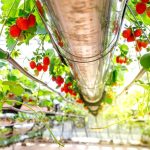
One of the challenges of growing food for the freshly-minted green thumb is deciding on space. Most rural or semi-rural folks simply dig a hole, put seeds or strawberry plants into the hole, and let the plants do their thing. Even city slickers often will have a usable section of their yard or space to build a raised-bed garden. Urban dwellers can often find an area for a community garden. But, particularly for those living in urban areas, space-utilizing tools are often employed to grow food in areas of contained soil. Usually, pots on a window sill or porch are used.
However, there is a new kid in town: the Topsy Turvy. There is also the Topsy Turvy Strawberry Planter, which is slightly better suited for strawberries. This post is a discussion of the pros and cons of growing topsy turvy strawberries.
Continue reading Topsy Turvy Strawberry Planter
Gardeners often want to know how many strawberry plants they will need to buy (Buy Strawberry Plants) and plant in order to achieve their desired strawberry harvest. Of course, there are quite a few variables involved with Growing Strawberries, and each Strawberry Variety is slightly different. However, if conditions are appropriate, soil and water requirements are adequately met, and weed, pests, and pathogens are effectively controlled, a fairly reliable harvest can be expected.
The three types of strawberry plants each produce different expected amounts of fruit. The following is a brief reference so that the anticipated harvest can be put to good use when it comes in. Be sure to plant enough plants to reap the rewards you seek!
Continue reading How Many Strawberries Do Strawberry Plants Produce?
Strawberries are a temperate plant. They can thrive in the chilly weather in the northern regions of the world and can even thrive at altitude on mountains. But, everyone loves strawberries, not just folks who happen to live in the optimal agricultural zones for growing the sweet strawberries. This post is to help the hot and humid gardeners find strawberries for Zone 9 that will perform adequately and allow an ample harvest.
There are three main areas that fall into Zone 9: California, Texas, and Florida. This simple post will help you choose a good strawberry variety for your area if you are a Zone Niner. To find out which Zone you are in, see the Zone Map on this Strawberry Planting Guide.
Continue reading Zone 9 Strawberries
0023 : Strawberry Plants Library
This is an entry in the Strawberry Plants Library here at Strawberry Plants .org. Continue reading for summarized information. The entire resource may be accessed or downloaded by clicking the link at the bottom of this post.
Continue reading Growing Strawberries in Wisconsin
Spring brings forth visions of harvest in the minds of home gardeners everywhere as they look at freshly planted gardens. As most gardeners know, everything does best when planted at its optimal time. Planting strawberries is no different. This strawberry planting guide will show you when you should put your strawberry plants in the ground. If you haven’t yet purchased any, you can follow this link to buy strawberry plants.
The following table tells you when to plant strawberry plants according to the U.S. agricultural zones:
Continue reading Strawberry Planting Guide
Companion planting has a long, storied history. Individuals have noted benefits (and drawbacks) when certain plant species are grown in close proximity to one another for hundreds of years, and many books have been written on the topic. Interestingly, the scientific causes of many of these relationships are not fully understood. But, the principles work and the beneficial symbiotic relationships can be measured among many types of plants.
The increased biodiversity is usually beneficial, but the planting of various plants in close proximity often yields multifaceted benefits. Two of the primary benefits are pest control and increased yield. There are many resources available to help develop a garden (or even a permaculture) that thrives based on mutual assistance and inter-connectivity of well-planned companion planting layouts. The purpose of this post, however, is to deal specifically with companion plants for strawberry plants and what benefits can be achieved by companion planting strawberries in your garden.
Continue reading Companion Planting Strawberries
Strawberry plants are a wonderful forb. Their life cycle is much more complicated than the simple appearance of the humble strawberry plant implies. The growth cycle of strawberry plants spans the entire year and repeats annually. The life cycle of strawberry plants begins either from seed or from runner plants, and continues until senescence. This post is an overview of the life of a strawberry plant from germination until withered, brown leaves signify the passage from life unto death.
The Growth Cycle of Strawberry Plants
As with any cyclical scenario, it is difficult to choose a starting point (which came first, the chicken or the egg?). For the purposes of describing the life cycle of strawberry plants, a dual starting point will be considered as a sprouted strawberry seedling and a new strawberry runner. While both of these starting points require the existence prior life, a discussion of the origins of life is outside the purview of this article.
Continue reading Life Cycle of Strawberry Plants
During the cold months of bitter chill and cabin fever of winter in the Northern Hemisphere, Green Thumbs everywhere begin to wistfully ponder the coming day when breaking ice gives way to breaking soil. When it is too cold outside to do much gardening and the only growing things are the icicles on the neighborhood gutters, many anxious gardeners sit down and plan their gardens. Which fruits and vegetables will be grown? How much space to allot to the staples and how much to unique, new, or exotic varieties? What will the layout be? Should the garden be planted in rows or according to the principles of square foot gardening?
Just thinking about it gets a Green Thumb’s sap flowing!
This year, consider sending out your runners in a new direction. If you have even a square foot or two of extra space in your fertile soil, consider planting a few pineberry plants. Pineberries are hybrid strawberries just like the normal strawberries you buy at the store or grow from ordered plants. The difference can be seen in the photo above. They are white strawberries with bright red seeds! And, they get their name from their unique pineapple/strawberry taste: PINEapple + strawBERRY = PINEBERRY.
If you are interested in learning about or growing this unique strawberry variety in your garden this year, you might want to click the following link now…
Continue reading Introducing the Pineberry
0017 : Strawberry Plants Library
This is an entry in the Strawberry Plants Library here at Strawberry Plants .org. Continue reading for summarized information. The entire resource may be accessed or downloaded by clicking the link at the bottom of this post.
Continue reading North Carolina Strawberries
|
|